

AAR Hospital Laboratory secures ISO 15189:2022 accreditation in Kenya
ISO 15189:2022 is an international standard that specifies requirements for quality and competence in medical laboratories.
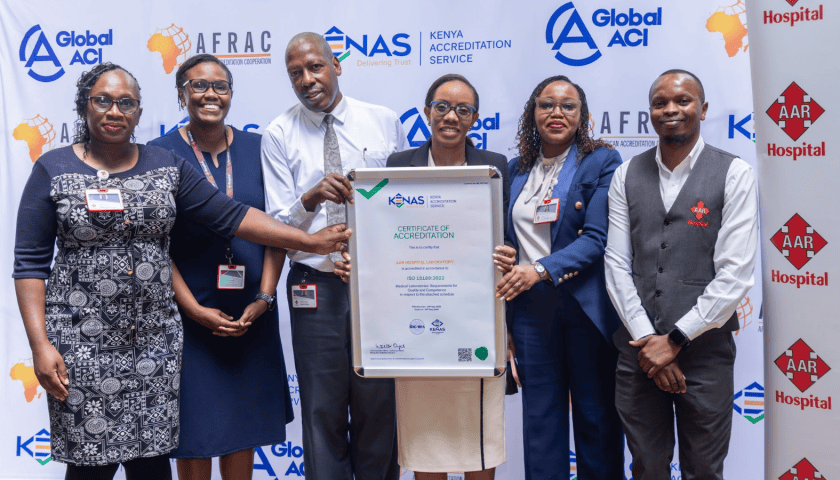
KENYA—AAR Hospital Laboratory has secured ISO 15189:2022 accreditation in Kenya, recognizing its laboratory quality management and technical competence in supporting reliable medical testing and patient care.
The accreditation reflects the laboratory’s efforts to strengthen testing procedures, maintain quality standards, and provide results that clinicians can use to guide patient management.
It also highlights the role of laboratory services in healthcare delivery, where accurate and timely results help inform diagnosis, treatment decisions and patient monitoring.
Accreditation reinforces laboratory quality standards
ISO 15189:2022 is an international standard that specifies requirements for quality and competence in medical laboratories.
It covers personnel competence, testing processes, equipment management, quality assurance, and the reliability of laboratory results.
For healthcare providers, accreditation to this standard provides a framework to evaluate laboratory operations and demonstrate that quality requirements are being met.
Laboratories must maintain documented procedures, monitor performance and manage risks that could affect the accuracy of test results.
AAR Hospital’s announcement marks a quality milestone for its laboratory team as the facility continues to support clinical services.
However, the announcement did not detail the accreditation’s scope, including the specific tests and laboratory disciplines covered.
Laboratory team leads quality improvement efforts
AAR Hospital credited its laboratory personnel with supporting the accreditation process, highlighting the contributions of Dr. Peris Thamaini, Head of Pathology; Jame Ndung’u, Laboratory Manager; and Anne Mutheu, Laboratory Quality Officer.
Their roles span laboratory oversight, day-to-day operations and quality management, which are central to maintaining consistent testing standards.
Laboratory accreditation typically requires coordination across these functions to ensure that procedures are documented, staff are competent, equipment is appropriately maintained, and deviations are addressed.
Quality officers also monitor compliance with established procedures, maintain records, and coordinate corrective actions when testing or operational processes fail to meet required standards.
These activities support continuous improvement and help laboratories identify potential sources of error.
Diagnostic quality remains central to patient care
Laboratory results influence a wide range of clinical decisions, from identifying infections and monitoring chronic diseases to assessing treatment responses.
Inaccurate or delayed results can complicate clinical assessments, making quality control an important part of patient safety.
Accreditation provides a structured approach to managing these risks, although it does not eliminate the possibility of errors.
Laboratories must continue to review their performance, investigate quality issues, and ensure that testing practices remain consistent with applicable requirements.
For hospitals in Kenya, internationally recognised laboratory standards can also support efforts to strengthen confidence in diagnostic services.
Reliable testing is particularly important as healthcare facilities respond to demand for timely diagnoses, appropriate treatment and better coordination between laboratory and clinical teams.
AAR Hospital said the achievement reflects its laboratory team’s commitment to improving service quality and supporting clinical decision making.
The facility recognised the staff involved in the process, with particular acknowledgement of the leadership provided by Thamaini, Ndung’u and Mutheu.

Be the first to leave a comment