
Kenya reaffirms ‘One Plan, One Budget’ approach in expanded Jhpiego health deal
Jhpiego will align its reproductive, maternal and newborn health programmes with the EWENE agenda, initially focusing on 18 priority counties identified by the Government.
KENYA—Kenya is strengthening strategic partnerships to accelerate progress towards Universal Health Coverage, with maternal and newborn health remaining a key priority in ongoing health-sector reforms.
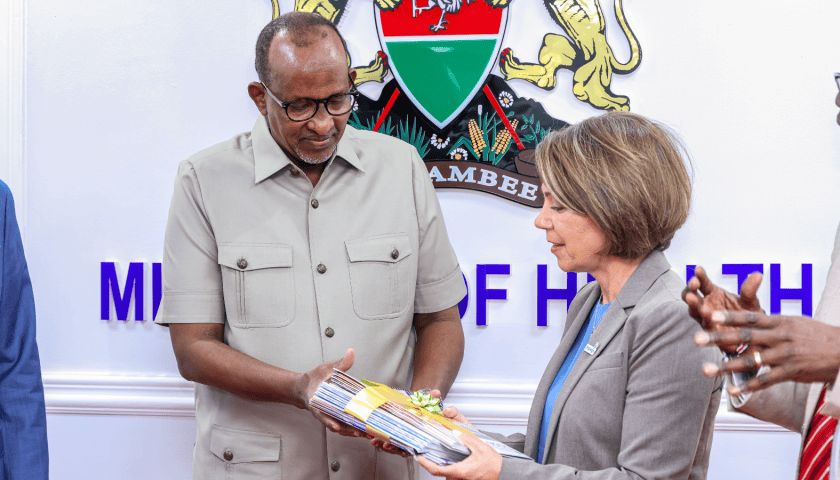
Health Cabinet Secretary Hon. Aden Duale met Jhpiego President and Chief Executive Officer Dr. Allyson Bear and her delegation to discuss expanded collaboration under the Government’s Every Woman, Every Newborn, Everywhere (EWENE) agenda.
During the meeting, Duale called for closer coordination between the Government and development partners to ensure that external support aligns with national priorities.
He reaffirmed the One Plan, One Budget and One Accountability principle, emphasising that partner resources should address the areas of greatest need while avoiding duplication.
The discussions identified maternal haemorrhage, healthcare-worker skills and access to appropriate technologies as priority areas requiring faster action.
Consequently, Jhpiego will align its reproductive, maternal and newborn health programmes with the EWENE agenda, initially focusing on 18 priority counties identified by the Government.
Expanding Newborn Care and Workforce Skills
The Ministry of Health welcomed Jhpiego’s planned support for newborn care in five counties. The Government will guide the selection of counties and health facilities that need the most support.
In addition, the partners will link maternal and newborn health interventions with existing HIV and family-planning programmes.
This approach will strengthen continuity of care for women from pregnancy through childbirth and the postnatal period.
Health-workforce development will also form a central part of the partnership.
Healthcare workers will receive mentorship, virtual learning and targeted capacity-building in line with Kenya’s national mentorship guidelines.
These activities will strengthen their ability to deliver quality maternal and newborn services.
Digital health to support decision-making
The collaboration will further promote digital health to improve planning and decision-making across the health sector.
The Ministry is developing a health-sector command-centre dashboard that will consolidate critical indicators, monitor programme performance and identify service gaps.
The dashboard will support timely action across maternal and newborn health, HIV, tuberculosis, and other priority programmes by giving policymakers a clearer view of performance and emerging needs.
Jhpiego has supported Kenya’s health sector for 48 years through programmes covering family planning, reproductive health, malaria, HIV, and maternal and newborn health.
Over the past two years, its portfolio has included 13 projects, with approximately KSh5.2 billion (US$40.2 million) invested across 22 counties and more than 1,800 health facilities.
Translating global commitments into action
The engagement also examined how commitments made at the Global Maternal Health Conference could translate into practical interventions in Kenya.
As the country pursues sustainable approaches to healthcare financing and service delivery, the Ministry said technical partnerships will remain important for strengthening national implementation capacity.
Duale said partnerships that bring expertise, innovation and resources should complement Government efforts, strengthen national health systems and deliver measurable improvements for Kenyans.
The Ministry of Health and Jhpiego reaffirmed their commitment to addressing persistent gaps in maternal and newborn care and advancing the EWENE agenda across Kenya.

Be the first to leave a comment