

Uganda signs deal with South Sudan to strengthen cross-border outbreak response
The agreement establishes a framework for joint action against Bundibugyo virus disease, viral haemorrhagic fevers, cholera and other infectious disease threats that could spread across the border.
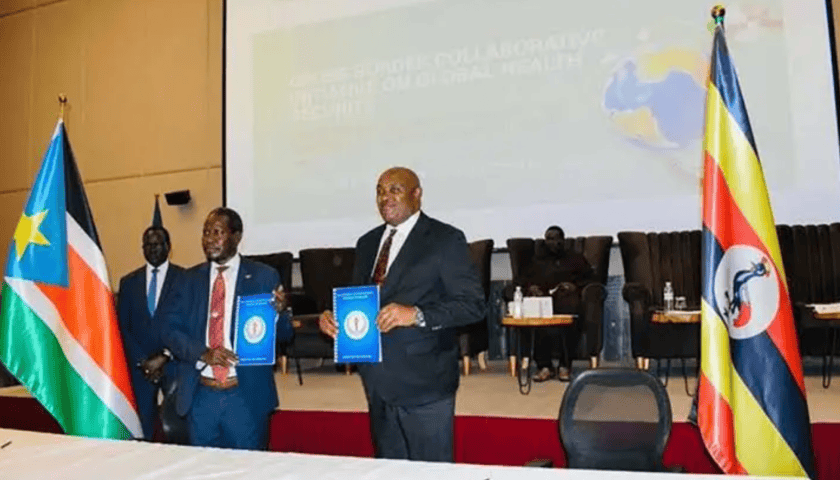
SOUTH SUDAN—Uganda and South Sudan have signed a Memorandum of Understanding (MoU) to strengthen cooperation in detecting, preventing, and responding to public health emergencies along their shared border.
Signed on 7 September, the agreement was facilitated by the Africa Centres for Disease Control and Prevention (Africa CDC), the UK Health Security Agency (UKHSA), and the World Health Organization (WHO) through the Continental Incident Management Support Team (IMST).
The agreement establishes a framework for joint action against Bundibugyo virus disease, viral haemorrhagic fevers, cholera and other infectious disease threats that could spread across the border.
Hon. Luke Thompson Thoan Teny, MP, Minister of Health of South Sudan, said the agreement would strengthen practical cooperation between the two countries through information sharing, joint preparedness and coordinated responses.
“This MoU should not be another protocol or MoU that is signed today and sits on a shelf tomorrow. We are deliberately trying to build something different: a model of cooperation that is adaptive, operational and accountable,” he said.
Coordinated outbreak response
The agreement comes as Uganda continues to manage an outbreak of Bundibugyo virus disease, highlighting the need for countries in the region to coordinate their response to infectious disease threats.
Although South Sudan has not reported a confirmed case, frequent movement of people across the porous border, combined with health system vulnerabilities, increases the risk of disease importation.
South Sudan is also responding to outbreaks of mpox, cholera and measles, as well as circulating vaccine derived poliovirus.
The MoU outlines measures for cross border disease surveillance and early warning, laboratory preparedness, sample referral and screening at points of entry.
It also covers infection prevention and control, case management, vaccination coordination, contact tracing, risk communication and community engagement.
The two countries will establish mechanisms for timely notification and information sharing while facilitating the movement of response personnel and essential supplies during emergencies.
Hon. Dr Chris Baryomunsi, MP, Minister of Health of Uganda, stressed the need to turn the agreement into measurable action and strengthen collaboration between health authorities on both sides of the border.
Building response capacity
Capacity building will form part of the implementation, with Uganda and South Sudan planning skills exchanges, mentorship programmes and joint simulation exercises.
These activities will support health workers, emergency response teams and institutions at national and subnational levels.
The agreement was signed in the presence of H.E. Hussein Abdelbagi Akol, Vice President of South Sudan and Chair of the Service Cluster, signaling political support for stronger cross-border health security.
He emphasised the need for a whole of government approach, saying, “Health security is national security.”
Dr Lul Riek, Senior Regional Representative at the Africa CDC Eastern Africa Regional Coordinating Centre, said the partnership demonstrates how African countries can work together to strengthen health security and sovereignty.
The MoU will remain in force for an initial three years and provide a platform for continued joint preparedness, surveillance and coordinated emergency response.

Be the first to leave a comment