Moderna launches in Vivo CAR-T mRNA therapy mRNA-6007 for autoimmune diseases
The announcement came during Moderna’s Science Day, where the biotechnology company outlined plans to broaden its pipeline across oncology, rare diseases, and immune-mediated disorders.
Published
USA—Moderna has unveiled its first in vivo chimeric antigen receptor T-cell (CAR-T) therapy program, marking a major expansion of its mRNA platform beyond vaccines and into autoimmune diseases.
The investigational therapy, mRNA-6007, is expected to enter clinical development next year as the company seeks to deliver a more accessible alternative to conventional CAR-T treatments.
The announcement came during Moderna’s Science Day, where the biotechnology company outlined plans to broaden its pipeline across oncology, rare diseases, and immune-mediated disorders.
Company executives described the new program as a key milestone in Moderna’s long-term strategy to become a diversified mRNA medicines company.
A simpler approach to CAR-T therapy
Traditional CAR-T therapies require doctors to remove a patient’s immune cells, genetically engineer them in specialized manufacturing facilities, and then infuse them back into the body after lymphodepleting chemotherapy.
While these treatments have shown remarkable success against some cancers and autoimmune diseases, they remain expensive, complex, and difficult to scale.
Moderna aims to overcome these challenges by engineering immune cells directly inside the body.
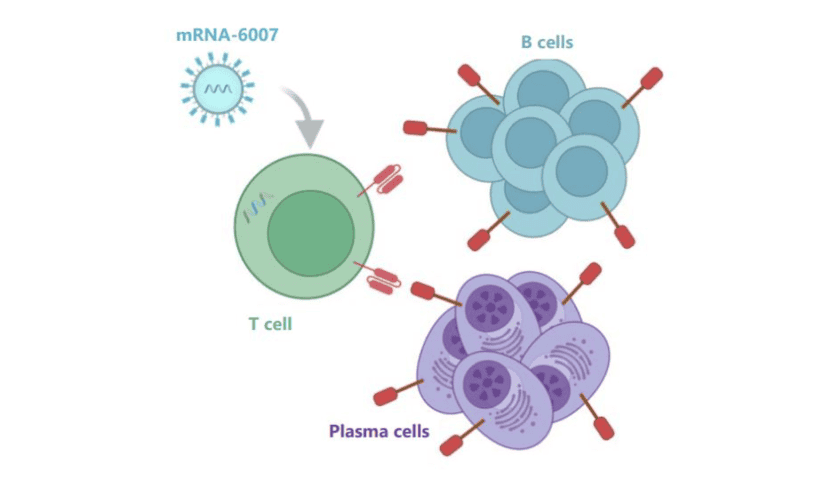
Its mRNA-6007 candidate uses lipid nanoparticles to deliver messenger RNA into CD4 and CD8 T cells, as well as natural killer cells.
Once inside, the cells temporarily produce CAR proteins that recognize and eliminate disease-causing B cells.
The therapy targets CD7-positive immune cells and is designed to produce transient CAR-T activity without the lengthy manufacturing process associated with conventional cell therapies.
Researchers believe this strategy could simplify treatment, reduce production costs, and make CAR-T therapy available to many more patients with autoimmune diseases.
Building on success in Lupus
Interest in CAR-T therapy for autoimmune diseases has grown rapidly following encouraging results from CD19-directed ex vivo CAR-T treatments in patients with severe lupus.
Those studies demonstrated that eliminating abnormal B cells could induce long-lasting disease remission in some patients.
Moderna hopes to achieve similar clinical benefits while avoiding the logistical hurdles of personalized cell manufacturing.
Although the in vivo approach may require multiple treatments, company researchers believe the convenience of an off-the-shelf product could outweigh the need for repeat dosing.
Rose Loughlin, PhD, Moderna’s head of research, said the platform could improve access to care while providing enough immune reprogramming to place autoimmune patients into remission after only a few doses.
The company is currently completing investigational new drug (IND)-enabling studies and conducting regulatory discussions before submitting its application to health authorities.
Initial clinical trials will evaluate mRNA-6007 across several B-cell-mediated autoimmune diseases, including systemic lupus erythematosus.
Part of a broader growth strategy
Moderna also described mRNA-6007 as the first application of its broader in vivo engineering platform.
If the program succeeds, the company plans to expand the technology into additional autoimmune conditions, oncology, and T-cell reprogramming therapies.
Chief Development Officer David Berman, M.D., PhD, noted that autoimmune diseases represent an attractive starting point because of their significant unmet medical need and large commercial potential.
He added that Moderna’s established expertise in manufacturing mRNA-lipid nanoparticle therapies at scale positions the company to meet future demand more efficiently than traditional CAR-T manufacturers.
Alongside the CAR-T program, Moderna highlighted progress across several other research programs during Science Day.
These included advancing its T-cell engager candidate mRNA-2808 for multiple myeloma, developing mRNA-2151 for ovarian cancer, and continuing clinical studies targeting Epstein-Barr virus-associated multiple sclerosis.
The company also reaffirmed its strategy of using artificial intelligence, machine learning, and robotics to accelerate drug discovery and expand its pipeline beyond infectious diseases.
Investor enthusiasm after the event pushed Moderna’s shares sharply higher, with analysts citing the new in vivo CAR-T platform as one of the company’s most significant pipeline announcements in recent years.
Sign up HEREto receive our email newsletters with the latest news and insights from Africa and around the world, and follow us on LinkedInfor updates.




Be the first to leave a comment