

Siemens Healthineers showcases Cios Go Mobile C-arm Platform at German Orthopedic Congress
The Cios Go ID addresses these challenges with a compact design and an integrated touchscreen display that clinicians can position according to their needs.
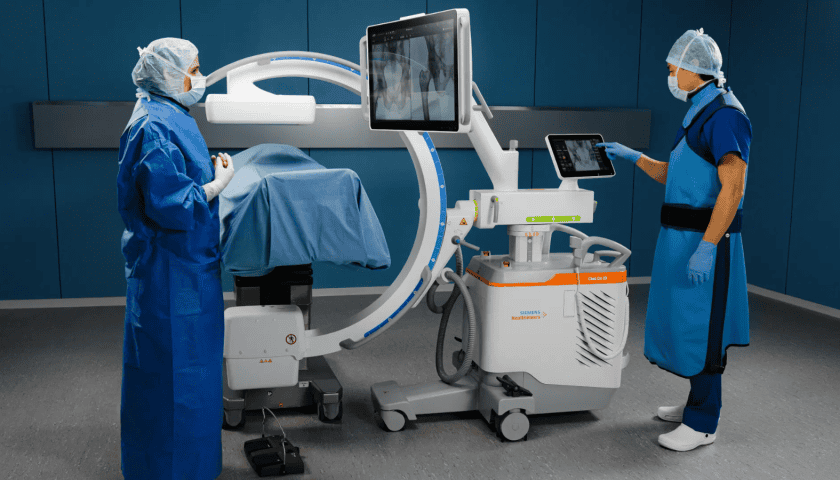
GERMANY—Siemens Healthineers is showcasing its Cios Go mobile C-arm imaging platform, including the Cios Go and Cios Go ID systems, at this year’s German Congress of Orthopedics and Traumatology to support intraoperative imaging and improve workflow efficiency across surgical settings.
Mobile C-arms provide real-time X-ray imaging during orthopedic, spinal, vascular and minimally invasive procedures, helping surgical teams assess anatomy, guide instruments and check implant placement.
However, limited operating room space, varied procedural requirements and the need for rapid equipment setup can complicate their use.
The Cios Go ID addresses these challenges with a compact design and an integrated touchscreen display that clinicians can position according to their needs.
The wider Cios Go platform offers configurations intended for different clinical environments and multidisciplinary applications.
Niclas Riege, a technologist in the Department of Trauma Surgery and Orthopedic Surgery at University Hospital Erlangen in Germany, highlighted the importance of equipment readiness in surgical practice.
He noted that delays in preparing operating rooms can disrupt workflows, making systems that are easy to position and operate valuable in busy clinical settings.
The platform includes Live Zoom, which allows clinicians to examine anatomical details and implant positioning through touch gestures, and SpotAdapt, which automatically adjusts brightness and contrast within a selected region.
Its generator options deliver 3.5 or 5 kilowatts (kW) of power, while detector sizes of 20 × 20 cm and 31 × 31 cm accommodate different imaging requirements.
The Retina Imaging Chain supports image quality across clinical applications while following the ALARA principle, which calls for keeping radiation exposure as low as reasonably achievable.
A 4K display also enables detailed image review during procedures.
Additional features include a green laser localizer for system and patient positioning, a Target Pointer to assist with screw and K-wire placement, and Live Graphical Overlay for touchscreen annotations.
Single-touch and multitouch controls, along with guided examination selection, are designed to simplify operation.
Mobility across clinical settings
Cios Go ID is designed for frequent transfers between clinical locations.
Its monitor arm lock secures the display during transport, while standby mode allows staff to disconnect and move the system before resuming operation, potentially reducing delays between procedures.
Johannes M. M. Groh, a consultant trauma and orthopedic surgeon at University Hospital Erlangen, said the system’s compact footprint allows it to fit into smaller operating rooms, emergency departments and outpatient facilities.
He also highlighted the flexibility of its integrated monitor, which can be positioned to provide a clear view during complex procedures involving multiple surgeons.
Peter Seitz, head of Image-Guided Surgery and Robotics at Siemens Healthineers, said the Cios Go platform combines imaging capabilities with user-focused controls to help surgical teams make timely decisions and manage intraoperative workflows.
The platform’s emphasis on mobility, adjustable displays, and simplified controls reflects the operational demands hospitals face when using imaging equipment across multiple surgical departments in space-constrained clinical environments.


Be the first to leave a comment