

Uganda Ministry of Health launches National Guidelines to improve sickle cell disease care
The guidelines establish a coordinated framework for improving screening, clinical management and access to quality healthcare for people living with the condition.
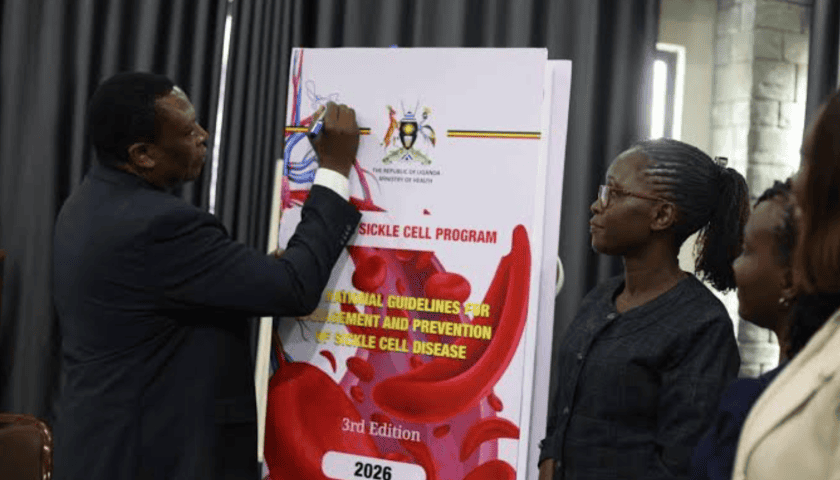
UGANDA—The Ministry of Health has launched national guidelines in Kampala to improve the prevention, early diagnosis and treatment of sickle cell disease (SCD), strengthening the country’s approach to managing the inherited blood disorder.
The guidelines establish a coordinated framework for improving screening, clinical management and access to quality healthcare for people living with the condition.
They also seek to strengthen the capacity of healthcare institutions and professionals to provide comprehensive care.
Speaking at the launch, Dr Charles Olaro, Director General of Health Services, called for a multisectoral approach involving government agencies, healthcare providers, medical training institutions and development partners.
He urged medical training institutions to strengthen their capacity to equip future health professionals with the knowledge and practical skills needed to manage the disease.
He also challenged stakeholders to develop an actionable roadmap that translates the guidelines into measurable interventions.
Strengthening healthcare capacity and partnerships
The Ministry of Health said the guidelines would provide a framework for improving prevention, diagnosis, treatment and long-term patient care.
Dr Miriam Ajambo, the ministry’s National Sickle Cell Coordinator, called for stronger partnerships and sustained investment from government and development partners to support implementation.
She emphasised the need to move beyond policy commitments and ensure that the guidelines improve healthcare delivery for affected individuals and families.
The launch was welcomed by the Sickle Cell Prevention and Care Society International (CAPSCI), which pledged to support implementation through community awareness, advocacy, early screening and diagnosis, psychosocial support, research and stronger referral systems.
The organisation stressed that effective implementation would require sustained collaboration between government, healthcare institutions, communities and development partners.
Implications for sickle cell services
The guidelines come at a time when strengthening early diagnosis and access to treatment remains important for reducing complications associated with sickle cell disease.
Their implementation will require investment in diagnostic capacity, healthcare worker training, patient monitoring and referral networks.
For Uganda’s healthcare sector, the framework provides an opportunity to improve coordination between primary healthcare facilities, specialised treatment centres and community-based organisations.
Stronger screening and referral systems could also support earlier intervention and reduce delays in accessing appropriate care.
Sickle cell disease is an inherited blood disorder caused by abnormal haemoglobin, the protein in red blood cells that transports oxygen throughout the body.
It can cause severe pain episodes, chronic anaemia, organ damage and other potentially life-threatening complications.

Be the first to leave a comment