

WHO hands over US$19,900 in ICT equipment to University of Ghana Public Health School
The new equipment will support a range of academic and institutional activities at the school. These include data analysis, research, lectures, seminars and virtual engagements.
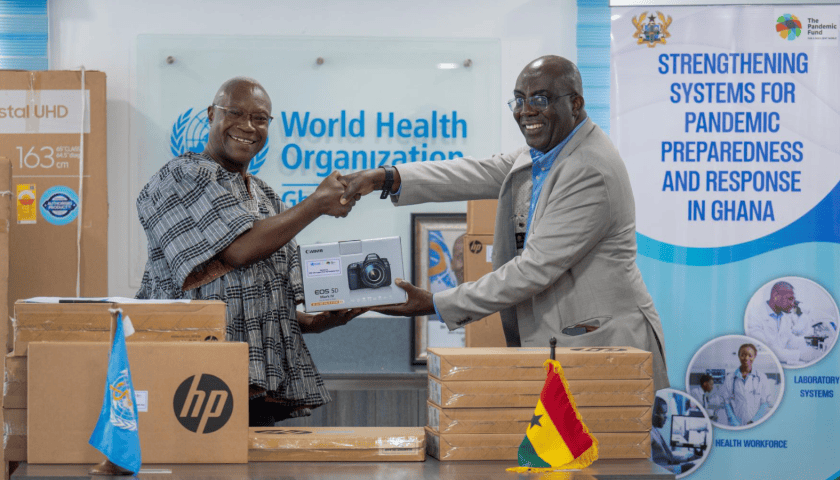
GHANA—The World Health Organization (WHO), through the Pandemic Fund Project, has provided ICT and media equipment valued at GHS 258,000 (US$19,900) to the University of Ghana School of Public Health to support teaching, research, knowledge sharing, and documentation.
The equipment includes six laptops, three desktop computers, two television sets, and a camera.
The support forms part of efforts to strengthen Ghana’s public health workforce and improve the country’s ability to prevent, detect and respond to public health emergencies.
Representing the WHO Representative to Ghana, Dr Fiona Braka, at the handover ceremony, Dr Frank Lule said investment in public health education and research is important to Ghana’s health security.
“By equipping institutions such as the School of Public Health with the tools they need, we are supporting the development of a skilled workforce that can generate evidence, innovate and contribute to effective preparedness and response to public health threats,” he said.
Equipment to support academic activities
The new equipment will support a range of academic and institutional activities at the school. These include data analysis, research, lectures, seminars and virtual engagements.
The camera will also support the documentation of fieldwork, training programmes and other public health activities.
According to WHO, the equipment will help the school share research findings and document its work more effectively while supporting faculty and students in their academic activities.
Prof. Kwesi Torpey, Dean of the University of Ghana School of Public Health, welcomed the support, saying it would provide a more suitable environment for teaching, learning, and research.
“This support comes at an important time for the school. The equipment will enhance how our faculty and students teach, learn, conduct research, and share knowledge.”
“More importantly, it strengthens our capacity to contribute to Ghana’s public health priorities and to develop the next generation of public health professionals,” he said.
Supporting Ghana’s public health workforce
The School of Public Health hosts Ghana’s Field Epidemiology and Laboratory Training Program and contributes to the training of public health professionals in areas such as health emergency management.
The school also conducts research and generates evidence to inform health policies and programmes in Ghana.
The support is part of the Pandemic Fund’s broader work to help countries improve their capacity for pandemic prevention, preparedness and response.
The fund invests in public health systems, institutions and the health workforce to help countries address current and emerging health threats.
WHO said it will continue working with the Government of Ghana, the University of Ghana and other partners to advance public health education and research and improve the country’s health security.
The equipment handover forms part of the ongoing collaboration between WHO and Ghanaian institutions to support public health training, research and preparedness.


Be the first to leave a comment