

Moscow Center develops 28 national standards for AI in healthcare
The standards aim to establish consistent methods for assessing AI algorithms before hospitals and other healthcare providers introduce them into clinical practice.
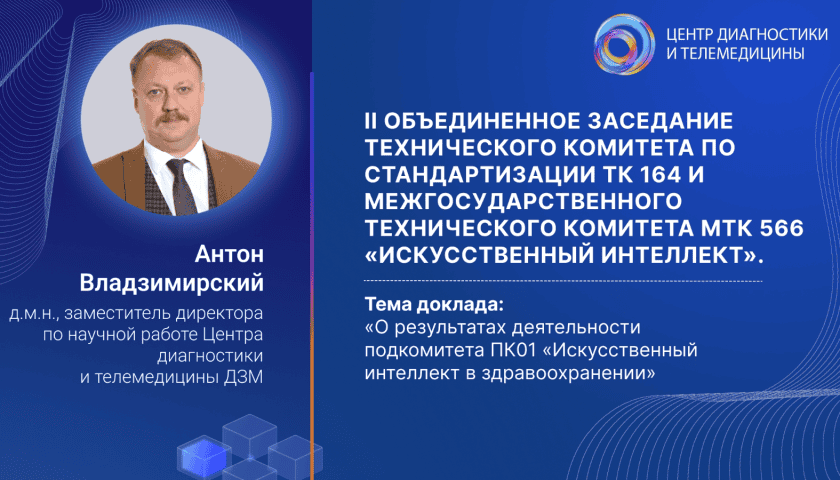
RUSSIA—Moscow’s Center for Diagnostics and Telemedicine has developed 28 national standards for artificial intelligence (AI) in healthcare to improve the safety, testing and clinical application of medical AI systems.
Anton Vladzymyrskyy, the Center’s Deputy Director for Research and Development, presented the results at the second joint meeting of Technical Committee 164 (TC 164) and Interstate Technical Committee 566 (ITC 566) on Artificial Intelligence.
He outlined the work of Subcommittee 01 (SC 01), which is responsible for establishing regulatory requirements for AI applications in healthcare.
Participants also reviewed the technical committees’ activities, discussed priorities for 2027 and considered plans to advance AI standardization across the sector.
Standards target AI safety and clinical performance
The standards aim to establish consistent methods for assessing AI algorithms before hospitals and other healthcare providers introduce them into clinical practice.
Since these systems support rather than replace clinical decision-making, healthcare professionals need reliable evidence of their accuracy, performance and safety.
Five new standards took effect in 2026, introducing benchmark datasets for testing neural networks and comparing their performance.
The Center has also secured approval for National Standard 72484-2025, which establishes common terminology and a classification framework for AI in healthcare.
“Artificial intelligence in medicine is not an autonomous digital doctor, but a tool used by a specialist,” Vladzymyrskyy said, explaining the need for clear requirements to ensure that medical AI systems operate safely and predictably.
Moscow experiment informs regulatory development
The Center’s standardization work draws on findings from the Moscow Experiment on Computer Vision Technologies, launched in 2020.
The initiative has processed more than 18 million medical examinations and deployed over 210 AI services to support medical image analysis.
The experience gained through the programme is informing the development of testing protocols and technical requirements for AI applications in clinical settings.
This approach could help healthcare providers assess solutions against consistent performance criteria before deployment, while giving developers clearer expectations for product validation and regulatory compliance.
New standards planned for generative AI and radiology
The Center is preparing additional regulatory documents addressing emerging applications of AI in healthcare.
Projects scheduled for 2026 include standards for large generative models that summarise electronic health records and requirements governing AI-assisted preventive and opportunistic screening in radiology.
Proposals submitted for the 2027 national standardization programme include guidelines for internal quality control of automated systems that analyse X-rays and other radiological images.
The programme will also address methods for evaluating image segmentation and morphometry, which involve identifying anatomical structures and measuring their characteristics.
The meeting further considered changes to the structure and membership of TC 164, the establishment of an interstate certification system and a proposed standardization roadmap for artificial intelligence covering 2026 to 2030.
Be the first to leave a comment