

Pfizer secures US$1.5B Blackstone funding to advance monthly obesity drug
The deal adds Pfizer to a growing list of pharmaceutical companies using Blackstone’s financing model to support drug development.
USA—Pfizer has secured US$1.5 billion from Blackstone Life Sciences to accelerate the clinical development of berobenatide, its monthly obesity treatment, as the US drugmaker seeks to strengthen its position in the growing weight-loss market dominated by Eli Lilly.
Under the agreement, Blackstone will finance berobenatide’s development costs through 2028.
In return, the investment firm will receive milestone-based payments if the drug secures US regulatory approval and achieves specified sales targets.
The arrangement does not give Blackstone any ownership rights over the drug.
The deal adds Pfizer to a growing list of pharmaceutical companies using Blackstone’s financing model to support drug development.
MSD, Johnson & Johnson (J&J), and Apogee Therapeutics have also entered funding arrangements with the investment firm.
Pfizer advances late-stage obesity programme
Although Pfizer has scaled back parts of its obesity research pipeline this year, berobenatide remains central to its strategy to enter the weight-management market.
The company acquired the drug, previously known as MET097i, through its US$10 billion acquisition of Metsera in December 2025.
The transaction followed a competitive bidding process involving Novo Nordisk.
Pfizer plans an extensive clinical programme covering 10 ongoing or planned Phase III studies.
Beyond chronic weight management, the company is evaluating berobenatide for obesity-related conditions, including knee osteoarthritis and obstructive sleep apnoea.
Pfizer Chief Financial Officer Cecile Guegan said the agreement would support the company’s comprehensive obesity programme while preserving its financial capacity to invest in other therapeutic areas.
Citi analysts described the financing arrangement as a way to improve the programme’s risk-adjusted economics and reduce Pfizer’s near-term development costs.
However, they identified clinical differentiation in efficacy, tolerability and monthly dosing as key factors that will determine the drug’s commercial prospects.
Lilly and Novo compete for market share
Pfizer faces established competitors in a market led by Eli Lilly.
The company’s dual-action drug, tirzepatide, marketed as Mounjaro for type 2 diabetes and as Zepbound for obesity, generated US$10.7 billion and US$5.4 billion in global sales, respectively, in the third quarter.
Combined quarterly revenue reached US$16.1 billion, exceeding the quarterly revenue of several major pharmaceutical companies, including Novartis, GSK and Bristol Myers Squibb.
Novo Nordisk also maintains a significant position through its semaglutide franchise, which now includes an oral formulation.
The company has accelerated the rollout of its Wegovy pill across the US, Europe and the UK, seeking to extend its reach beyond injectable treatments.
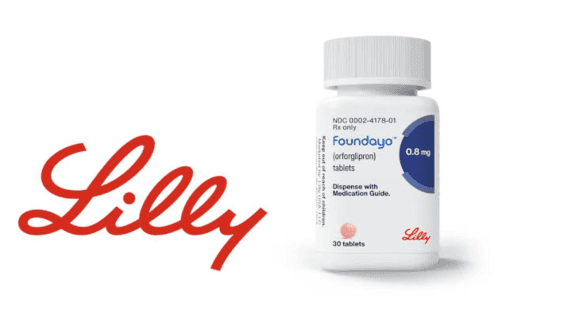
Meanwhile, Lilly is advancing its oral obesity drug Foundayo (orforglipron), which offers an alternative administration option.
The drug secured its first approval in China, giving Lilly an additional route into the expanding oral weight-loss market.
Be the first to leave a comment