

HPPI presents model for dual TB-HIV integration at AIDS 2026 Conference
Rather than creating entirely new programmes, HPPI has worked to strengthen TB services within established HIV platforms while using a person-centred, community-led approach.
BY Shobha Shukla – CNS (Citizen News Service)
INDIA—Tuberculosis (TB) remains the most common opportunistic infection and a leading cause of death among people living with HIV, despite decades of progress in diagnosis, treatment, and prevention.
Although TB is both preventable and curable, more than 150,000 people living with HIV died from TB in 2024, according to the latest UNAIDS report, launched at the 26th International AIDS Conference (AIDS 2026).
“If we could have prevented TB better among people with HIV or found TB earlier and treated it with medicines that work against their TB bacteria, we could have saved these lives. No one needs to die of TB or HIV,” said the Prevent-Find-Treat ALL TB campaign.
More than 570,000 people died from AIDS-related illnesses in 2025.
The challenge extends beyond the availability of effective medical tools. Health systems must also identify people early and connect them with appropriate care before disease progresses, while protecting their dignity and right to health.
Experiences shared by experts from Humana People to People India (HPPI) at AIDS 2026 suggest that India could address this gap by integrating the latest science and evidence-based TB services into established HIV care and prevention platforms. The approach focuses on person-centred care and community leadership rather than creating entirely new programmes.
HPPI National Partnership Officer Jahangeer Alam, a TB survivor and TB champion, and National Technical Advisor for TB, HIV and Health Dr Sugata Mukhopadhyay described how stronger collaboration between the Government of India’s National TB Elimination Programme (NTEP) and National AIDS Control Programme (NACP) is helping to identify TB earlier, improve treatment completion and put people, rather than diseases, at the centre of healthcare.
Why TB can be difficult to detect in People Living with HIV
According to Alam, TB remains the leading cause of death among people living with HIV and accounts for about one in four HIV-related deaths globally.
However, TB in people living with HIV does not always present with the symptoms traditionally associated with the disease. Some people may not experience persistent cough, fever, weight loss or other commonly recognised symptoms.
As a result, health systems that rely primarily on symptom-based screening can miss infections until the disease has progressed.
Delayed diagnosis can worsen health outcomes and increase the risk of continued transmission. At the same time, TB screening is not always fully integrated into routine HIV care and antiretroviral therapy (ART) services.
Persistent stigma associated with both HIV and TB can further discourage people from seeking care early. Consequently, integrating the two services is not simply a matter of improving efficiency; it is also a clinical and human rights priority.
Using existing HIV platforms to find TB earlier
To address these challenges, HPPI worked with government-run ART centres in Delhi and the NTEP to strengthen TB-HIV integration.
Rather than creating new systems, the organisation used existing HIV care platforms to actively screen people attending ART centres for TB.
Since December 7, 2024, the government’s TB programme has also incorporated a science- and evidence-based approach to case finding by deploying artificial intelligence (AI)-enabled handheld, ultraportable X-ray systems and offering upfront molecular testing to people with presumptive TB.
The programme has taken these technologies in mobile vans to high-risk communities across the country. According to the programme, this approach identified more than one million asymptomatic people with TB disease within a year, enabling them to receive diagnoses earlier than would have been possible through symptom-based approaches alone.
Between May and July 2026, HPPI screened 1,363 people living with HIV using a comprehensive 10-symptom verbal screening tool alongside chest X-ray assessments. People identified as having presumptive TB subsequently underwent upfront rapid molecular testing.
The screening identified 259 people with presumptive TB, all of whom received diagnostic testing. Twenty-one people were diagnosed with TB and promptly linked to treatment.
Notably, 12 of the 21 people diagnosed with TB, or 57%, had no symptoms.
For Alam, the finding highlighted why the absence of symptoms cannot be taken as evidence that TB is absent.
Without systematic screening that combines symptom assessment, chest X-ray and rapid molecular testing, more than half of these TB cases could potentially have remained undetected.
The experience also demonstrated that every interaction between people living with HIV and healthcare providers can provide an opportunity to identify TB before the disease becomes severe.
Extending TB services into HIV prevention networks
ART centres provide an important point of contact, but Mukhopadhyay highlighted another opportunity: India’s extensive community-based HIV prevention network.
The country’s HIV prevention programme currently reaches approximately 15.8 million people through Targeted Intervention projects, Link Worker Scheme projects, Opioid Substitution Therapy centres and other outreach platforms.
These populations include female sex workers, gay men and other men who have sex with men, transgender people, people who inject drugs, migrant workers and truckers. Many face an increased risk of HIV as well as vulnerabilities associated with TB.
Rather than establishing separate TB programmes for these groups, HPPI trained existing outreach workers to incorporate TB services into their routine activities.
Community workers received training to screen for TB symptoms, educate communities about TB and HIV, address stigma and establish referral pathways with the NTEP for diagnosis, treatment and preventive therapy.
The approach builds on relationships that already exist within communities. Instead of introducing unfamiliar healthcare workers, the programme uses outreach teams that understand where vulnerable populations live and work and where they seek support.
This familiarity can help build trust and encourage people to seek care.
Supporting patients beyond diagnosis
HPPI’s approach extends beyond identifying TB cases. Mukhopadhyay said the organisation supports people throughout the continuum of care, from diagnosis and treatment initiation to adherence and completion.
Where appropriate, the programme also supports TB preventive treatment for eligible household contacts and people living with HIV. Regular community-based follow-up helps underserved people navigate the journey from diagnosis to treatment and, ultimately, cure.
HPPI drew on experience from four projects: three Targeted Intervention projects in Delhi, Unnao in Uttar Pradesh and Kathakota in Telangana, as well as a Link Worker Scheme project in Lucknow.
Across these projects, the organisation integrated TB activities into routine HIV outreach without establishing a separate service-delivery structure.
Data from the five-year period between 2020 and 2025 showed the potential of the approach.
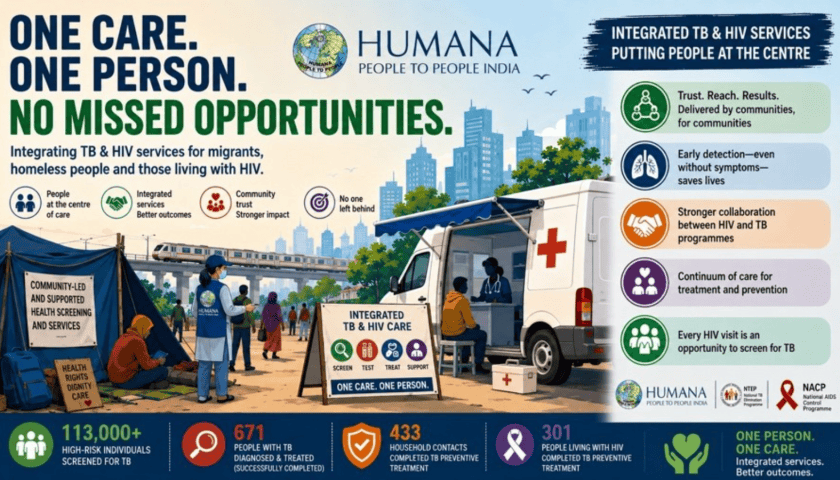
Among populations at high risk of HIV, more than 113,000 people were screened for TB symptoms. The screening resulted in 671 TB diagnoses, with all diagnosed individuals initiated on treatment and completing it successfully.
The programme also supported 433 eligible household contacts to complete TB preventive treatment, helping reduce their risk of developing active TB.
Among people living with HIV, more than 500 individuals were screened, 11 were diagnosed with TB and all were started on treatment. In addition, 301 eligible people living with HIV completed TB preventive treatment.
For Mukhopadhyay, however, the figures represent only part of the programme’s impact. He emphasised that the experience demonstrated how comprehensive TB services can be delivered through existing HIV programmes without establishing parallel systems or requiring substantial additional resources.
Strengthening the role of community health workers
Alam and Mukhopadhyay stressed that integration does not simply mean combining two health programmes. Instead, it involves making better use of existing systems, personnel and community networks.
HPPI strengthened the skills of frontline workers, expanded their responsibilities and improved coordination with government health programmes.
Community outreach workers became an important part of the model. Their responsibilities included screening for TB symptoms, providing health education, reducing stigma, facilitating referrals, following up on treatment, supporting adherence and assisting with contact investigations.
They also provided regular support to people and families who might otherwise struggle to navigate the healthcare system.
Because these workers already have trusted relationships within their communities, they can reach people who may avoid health facilities because of discrimination, fear or other social barriers.
This use of existing relationships also makes service integration more practical and potentially more cost-effective.
As Mukhopadhyay put it, the approach was about “doing things differently—not necessarily doing more things separately.”
Five actions for stronger TB-HIV integration
Alam and Mukhopadhyay identified five actions they believe can strengthen TB-HIV integration.
First, symptom-based screening alone is insufficient for people living with HIV. Additional diagnostic approaches, including chest X-rays and upfront rapid molecular testing, can identify TB in people who do not have obvious symptoms. All services should also remain person-centred, community-based, community-led and rights-based, while ensuring equitable access.
Second, every interaction with HIV services should provide an opportunity to screen for TB. Waiting until symptoms become severe can result in delayed diagnosis, higher healthcare costs, continued transmission and poorer outcomes.
Third, government HIV services and the NTEP need strong coordination. Screening has limited value if people do not receive rapid testing, timely treatment and support throughout their care.
Fourth, community-based outreach should remain a core component of TB and HIV programmes. Trusted frontline workers can help address stigma, improve awareness and maintain continuity of care beyond health facilities.
Finally, integration can make financial as well as public health sense. Existing health systems, trained personnel and established community platforms already provide much of the infrastructure required. Better coordination can therefore deliver greater impact without necessarily requiring substantially higher expenditure.
Moving from Disease-Centred to Person-Centred Care
Healthcare systems often organise services around individual diseases, but people experience health differently.
A person living with HIV does not experience TB, HIV, nutrition, mental health and other health concerns as separate programmes. Instead, these issues can intersect and affect the same person’s life.
Alam and Mukhopadhyay therefore argued that health services should reflect this reality.
When TB and HIV services operate independently, opportunities for early diagnosis, prevention and treatment can be missed. By integrating services, healthcare providers can identify problems earlier, provide more comprehensive care and coordinate interventions instead of operating in isolation.
The approach places greater emphasis on supporting people rather than managing diseases separately.
Building on existing health systems
As India continues its efforts to eliminate TB and AIDS by 2030, HPPI’s experience highlights an approach that builds on existing health infrastructure, HIV programmes and community networks.
The organisation’s projects show that integrating community-based TB screening, diagnosis, treatment and prevention into established HIV platforms can help identify otherwise undetected cases, support treatment completion and expand access to preventive care among vulnerable populations.
The experience also demonstrates the role that collaboration among national health programmes, community organisations and frontline workers can play in strengthening the continuum of care.
At AIDS 2026, Alam and Mukhopadhyay emphasised the importance of organising healthcare around people’s needs rather than around separate disease programmes.
In their view, coordinated TB and HIV services can help ensure earlier diagnosis, timely treatment, preventive care, and continued support for people living with HIV.


Be the first to leave a comment