
Sidra Medicine calls for faster clinical adoption of microbiome research at MENA Microbiome 2026
The two-day conference brought together international scientists and healthcare professionals to discuss the role of the microbiome in disease, advances in rapid metagenomics, antimicrobial resistance (AMR), and new approaches to predicting and managing sepsis.
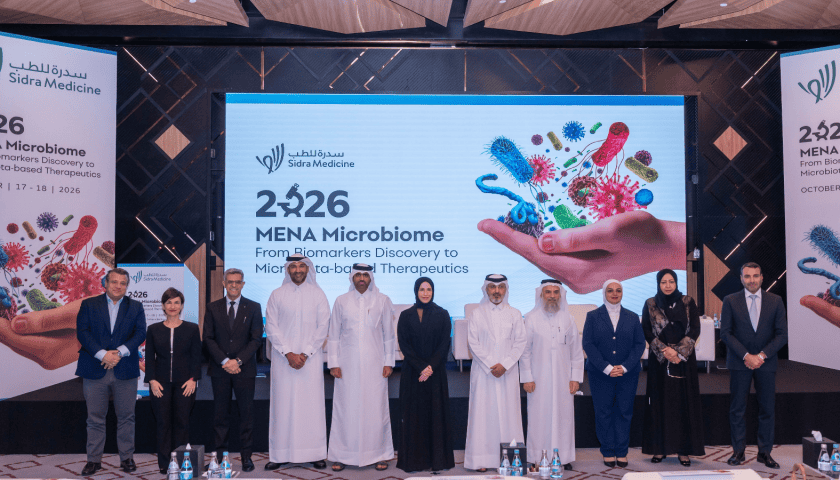
QATAR—Sidra Medicine has concluded MENA Microbiome 2026 in Qatar, calling for stronger collaboration between researchers and healthcare providers to translate microbiome discoveries into practical diagnostic and treatment tools.
The two-day conference brought together international scientists and healthcare professionals to discuss the role of the microbiome in disease, advances in rapid metagenomics, antimicrobial resistance (AMR), and new approaches to predicting and managing sepsis.
Advancing microbiome research and clinical practice
The opening ceremony featured Mohammed Khalid Al Mana, Acting Chief Executive Officer and Member of the Board of Governors at Sidra Medicine; Professor Ibrahim Janahi, Chief Medical Officer; and Professor Khalid Fakhro, Chief Research Officer.
They highlighted the importance of research innovation, multidisciplinary partnerships and translating scientific findings into better patient care.
Qatar’s Minister of Social Development and Family, Buthaina bint Ali Al Jabr Al Nuaimi, also attended the ceremony alongside healthcare leaders and international scientific experts.
Al Mana emphasised that scientific progress must translate into meaningful benefits for patients and communities.
He also acknowledged the Ministry of Public Health’s support as the conference’s strategic sponsor.
Fakhro highlighted the need for closer links between laboratory research and clinical practice, allowing findings from patient care to inform further scientific investigation.
A keynote presentation by Dr Jacques Ravel explored the relationship between the microbiome and women’s reproductive health, including opportunities to develop targeted interventions for reproductive and gynaecological conditions.
Other sessions examined how interactions between the gut microbiome and organs such as the brain and kidneys may influence disease development.
Researchers discussed how these relationships could help identify biomarkers and support more personalised treatment approaches.
The programme also explored rapid metagenomic sequencing, which can help identify infectious pathogens and characterise antimicrobial resistance.
Faster identification could support more timely treatment decisions, particularly in critically ill patients.
Experts examine the path to clinical implementation
A panel discussion titled “Microbiome and Metagenomics: How to Move from Research to Clinical Implementation” brought together Dr Majdi Osman, Dr Nikhil Pai, Dr Mamoun Elawad and Dr Sara Abdullah.
Professor Hilal Lashuel, Research Development and Innovation Advisor to the Chairperson of Qatar Foundation, moderated the session.
The panellists examined progress in microbiome science and the steps needed to turn research findings into reliable diagnostic tests and therapeutic approaches.
Elawad, Chief of Pediatric Gastroenterology at Sidra Medicine, stressed that closer alignment between translational research and clinical services is essential to delivering safe, individualised care.
Qatar institutions collaborate on early sepsis prediction
Sidra Medicine is working with Hamad Medical Corporation (HMC) and Weill Cornell Medicine Qatar on a research project to improve early sepsis prediction and management.
Funded by the Qatar Research, Development and Innovation Council under its ARG1 funding call, the study is recruiting critically ill patients admitted to HMC intensive care units to establish a sepsis biorepository.
Researchers are combining metagenomic sequencing and proteomics to investigate biological indicators associated with sepsis and characterise antimicrobial resistance profiles.
The project aims to identify patients at risk before their condition deteriorates, potentially enabling earlier intervention and more targeted treatment.
Sepsis occurs when the body’s response to infection causes organ dysfunction.
Early recognition and treatment are essential to reducing the risk of septic shock and organ failure.
Dr Souhaila Al Khodor, the study’s lead principal investigator at Sidra Medicine and a conference co-chair, said the research would examine whether molecular changes could help predict sepsis and improve understanding of antimicrobial resistance.
Dr Ali Ait Hssain, Director of Critical Care at Aisha bint Hamad Al Attiyah Hospital, said the collaboration combines HMC’s clinical experience with Sidra Medicine’s metagenomics expertise.
Weill Cornell Medicine Qatar contributes additional academic and scientific capabilities.
Sidra Medicine announces upcoming genomics summit
The conference co-chairs, Al Khodor and Dr Annalisa Terranegra, called for continued cooperation among researchers, clinicians and healthcare institutions to advance the clinical application of microbiome science.
Sidra Medicine will host the 12th Precision Medicine and the Future of Genomics (PMFG) Summit from 7 to 9 December 2026.
The event will cover advances in genomics, multi-omics, and precision medicine, with discussions on translating research into clinical practice and developing more personalised healthcare approaches.


Be the first to leave a comment