

Cambodia becomes first in Asia-Pacific to achieve 95-95-95 HIV targets
The 95-95-95 targets aim for 95% of people living with HIV to know their status, 95% of those diagnosed to receive antiretroviral treatment, and 95% of those receiving treatment to achieve viral suppression.
BY Shobha Shukla – CNS (Citizen News Service)
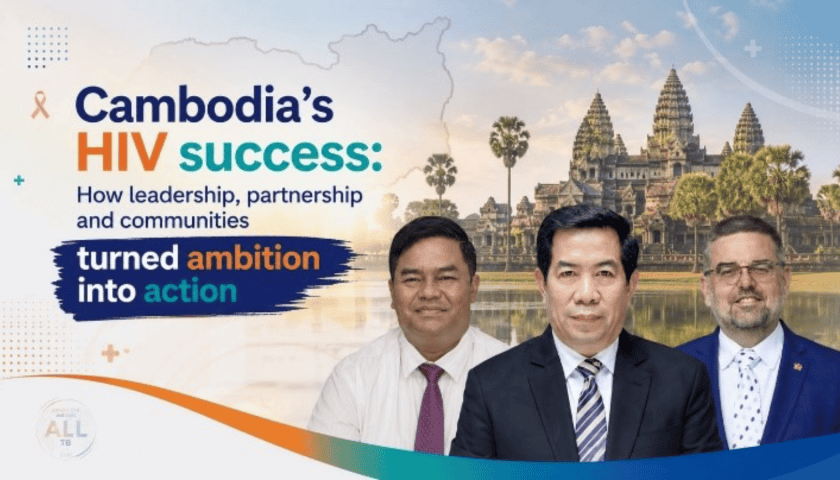
CAMBODIA—Cambodia has become the first country in the Asia-Pacific region to achieve the UNAIDS 95-95-95 HIV targets, demonstrating the impact of sustained political commitment, community involvement, and evidence-based HIV programmes.
The achievement means that more than 95% of people living with HIV in Cambodia know their status, 100% of those diagnosed are receiving lifesaving antiretroviral therapy (ART), and 98% of people on treatment have an undetectable viral load.
Eamonn Murphy, UNAIDS Regional Director for Asia Pacific, Eastern Europe and Central Asia, said Cambodia’s progress demonstrates what national leadership and strong community partnerships can achieve.
The 95-95-95 targets aim for 95% of people living with HIV to know their status, 95% of those diagnosed to receive antiretroviral treatment, and 95% of those receiving treatment to achieve viral suppression.
People with an undetectable viral load cannot sexually transmit HIV, a principle commonly expressed as “undetectable equals untransmittable”, or U=U.
According to the latest UNAIDS report, released in 2026, 14 countries had achieved the 95-95-95 targets by 2025: Botswana, Cambodia, Denmark, Eswatini, Lesotho, Namibia, Rwanda, Saudi Arabia, Sweden, Zambia and Zimbabwe.
Strong political commitment drives progress
Dr Ouk Vichea, Director of Cambodia’s National Centre for HIV/AIDS, Dermatology and STI (NCHADS) at the Ministry of Health, said the country’s progress reflects decades of sustained political commitment.
“Cambodia’s progress in the HIV response offers a clear lesson: ambitious public-health targets can be reached when political leadership, evidence-based action and communities work together,” he said.
The Royal Government of Cambodia, the Cambodia National Authority and the Ministry of Health have kept HIV high on the national agenda for decades.
This commitment has translated into policies, coordinated action and collaboration with development partners, including UNAIDS, the World Health Organization (WHO) and the Global Fund to Fight AIDS, Tuberculosis and Malaria.
Dr Ouk said the achievement goes beyond a technical milestone. Instead, it reflects Cambodia’s ability to turn evidence, innovation and political commitment into practical programmes.
Communities at the centre of the HIV response
Choub Sok Chamreun, Executive Director of KHANA Cambodia, attributed the country’s progress to a strong partnership among government, civil society, communities and people living with HIV.
“The success of Cambodia is because of very strong partnership from the beginning,” he said.
This partnership has enabled key populations and people living with HIV to play an active role in designing, delivering and monitoring HIV services. These groups include gay men and other men who have sex with men, transgender people, people who use and inject drugs, and female entertainment workers.
Chamreun said consultation alone is not enough. Communities must participate directly in planning and implementing programmes, particularly because people with lived experience often understand barriers to healthcare that may not be apparent to service providers.
Community workers can also reach people in settings where conventional health services may have limited access. They can provide services in remote areas, at night and during weekends while reaching people who may avoid health facilities because of stigma and discrimination.
KHANA Cambodia’s programmes illustrate the scale of this community-led approach. The organisation has 153 outreach workers in one programme, 49 serving female entertainment workers, and another 153 reaching gay men and other men who have sex with men and transgender people. Its tuberculosis (TB) response also involves 309 volunteers.
Using data and innovation to close gaps
Cambodia has also strengthened its HIV response by combining multiple prevention approaches rather than relying on a single intervention.
Dr Ouk said the country has expanded differentiated HIV testing, pre-exposure prophylaxis (PrEP) and other prevention tools while integrating services to address gaps among key populations.
The government also uses several sources of data to guide its response.
Dr Ouk described this approach as a “triangle” comprising routine programme data, integrated biological and behavioural surveillance (IBBS), and community monitoring data.
These sources help identify gaps in services and allow programmes to adjust their approaches according to the needs of different populations.
The focus, therefore, extends beyond making services available. Cambodia also aims to ensure that services are accessible, acceptable and trusted by the people who need them.
Persistent challenges remain
Despite the progress, Cambodia continues to face challenges in preventing new HIV infections.
Dr Ouk noted that new infections remain concentrated among key populations, while stigma, discrimination and social inequalities continue to prevent some people from accessing HIV services.
As a result, achieving the 95-95-95 targets does not mark the end of Cambodia’s HIV response. Instead, the country must sustain its gains while addressing the structural barriers that continue to affect prevention and treatment.
Chamreun also stressed the importance of maintaining close cooperation between government, civil society and communities in both HIV and TB programmes, particularly as financial resources become more constrained.
Sustaining the response amid funding pressures
Declining external funding has increased the need for stronger partnerships and greater domestic investment.
“Partnerships become even more critical when funding plummets,” Chamreun said, noting that fragmented efforts can increase costs, while collaboration allows organisations to share expertise and resources.
Dr Ouk similarly called for sustained political leadership and increased domestic financing, particularly for HIV prevention and community-led programmes.
He also emphasised the need to expand innovation and ensure that new approaches reach the populations that need them most.
Cambodia is now entering a new phase focused on greater country ownership and sustainability.
Dr Ouk said the 95-95-95 achievement represents a milestone, while the next priority is to sustain progress, strengthen services and make the HIV response more equitable.
Chamreun said people living with HIV and affected communities must remain central to this effort because their experiences provide valuable insight into community needs and gaps in existing services.

Be the first to leave a comment