

Indonesia calls for people-centred HIV & TB response ahead of 2030 goals
Community advocacy contributed to an Indonesian Ministry of Health regulation that allows young people under 18 to be accompanied not only by parents but also by community members and outreach workers when accessing HIV testing.
BY Shobha Shukla – CNS (Citizen News Service)
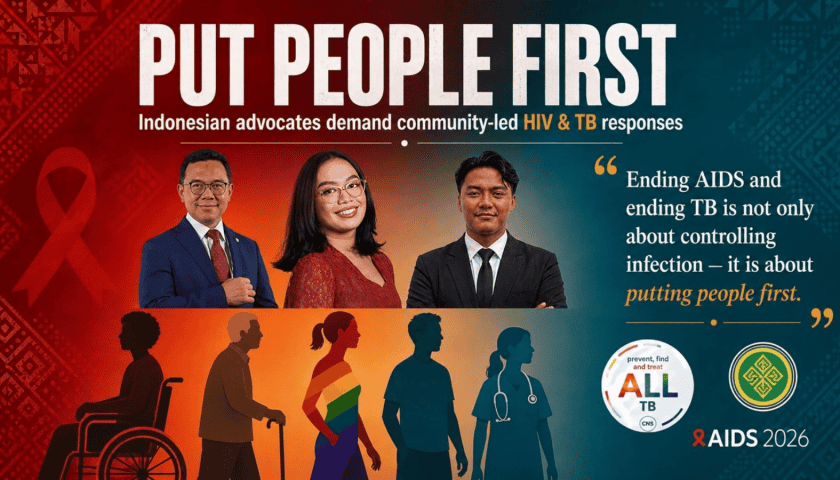
INDONESIA—As countries work towards the 2030 Sustainable Development Goals, Indonesian health officials and community advocates are calling for a stronger, people-centred approach to HIV and tuberculosis (TB).
They argue that medical treatment alone cannot overcome the stigma, discrimination, policy barriers, and limited access that prevent vulnerable communities from receiving care.
Dr Imran Pambudi, a senior public health leader at the Indonesian Ministry of Health who currently serves as Director of Health Services for Vulnerable Populations, said efforts to end AIDS and TB must address the realities faced by people living with and affected by the diseases.
“Ending AIDS and ending TB is not only about controlling infection—it is about putting people first,” Pambudi said.
He said putting people first is essential to moving from disease control towards disease elimination.
Community-led HIV and TB programmes, he added, should be assessed not only by the number of people they reach but also by their impact on people’s lives and their ability to remove barriers to care.
Pambudi has more than two decades of experience leading national programmes on HIV/AIDS and TB control, pandemic preparedness and youth mental health. He has also advocated for inclusive healthcare for marginalised communities.
For Bella Aubree, a transgender woman and National Coordinator of Inti Muda Indonesia who chairs the Global Fund Youth Council, putting people first is particularly important for young people, including those under 18 who face a risk of HIV but often remain overlooked by conventional health programmes.
Aubree said Indonesia’s HIV response broadly targets key populations but lacks adequate infrastructure specifically designed for young key populations under 18 who acquire HIV through horizontal rather than vertical transmission.
This gap creates what she described as a “missing wedge” in HIV programming.
Removing barriers to HIV services for young people
Several factors can prevent young people from accessing HIV services.
These include clinic hours that conflict with school schedules, fear of disclosure to parents or guardians, limited adolescent-friendly HIV services and a shortage of youth-focused peer support.
As a result, some young people may remain untested and untreated, fail to achieve viral suppression or disengage from care before receiving appropriate treatment.
Aubree described a community-based approach that combines demand generation, peer outreach, digital engagement and youth events with practical access to HIV testing and treatment.
Social media and digital platforms can raise awareness, build trust and encourage young people to seek testing.
At the same time, youth festivals, community events and HIV literacy programmes can strengthen understanding of HIV and help young people assess their risk.
However, generating demand is only the first step. Aubree said services must also be safe, accessible, acceptable and responsive to the needs of young people.
In Indonesia, community programmes have used point-of-care and decentralised testing, hotspot outreach and door-to-door services.
These approaches remain important because geographical distances can make it difficult for people in some areas to reach health facilities.
“Door-to-door services are still needed by the youth in Indonesia,” Aubree said.
She also called for extended clinic hours to accommodate adolescents and young adults whose school schedules make conventional clinic hours difficult.
She said community programmes should also provide mental health and psychosocial support, paralegal assistance, community-led monitoring and policy advocacy.
Through community-led monitoring, young people can provide feedback on the quality of health services and use the findings to advocate for improvements with the Indonesian Ministry of Health and sub-national health authorities.
Community advocacy and policy change
Aubree stressed that community advocacy remains important as new technologies, including artificial intelligence, become increasingly prominent in healthcare.
Communities, she said, can help bridge the gap between health providers and people who may distrust formal health systems.
“Marginalised young key populations trust communities first,” she said.
Aubree highlighted access to HIV testing as an example of how policy barriers can affect young people. Before 2022, people under 18 in Indonesia generally required parental consent to access HIV testing.
For young people who feared anger, discrimination or disclosure within their families, bringing a parent or guardian to obtain an HIV test could create a significant barrier to care.
Community advocacy contributed to an Indonesian Ministry of Health regulation that allows young people under 18 to be accompanied not only by parents but also by community members and outreach workers when accessing HIV testing.
However, Aubree said having a policy in place does not automatically guarantee that health facilities will implement it consistently.
She and other advocates have continued calling for a circular letter to health services across Indonesia to clarify that young key populations under 18 can access HIV testing under the new framework.
She said the advocacy process has already taken years.
“If there is a policy barrier,” she said, “this is something that we need to change.”
The issue highlights a wider challenge for Indonesia’s HIV response: translating national policies into services that people can actually access.
Reviews of the country’s HIV programme have also identified gaps in coordination, service integration and sustainability, as well as the need for stronger community support and efforts to reduce stigma.
Safety, ageing and disability in HIV care
For Pambudi, removing these barriers forms part of a broader commitment to ensuring that vulnerable people are not excluded from HIV and TB programmes.
He identified three priorities: safety, ending ageism and improving accessibility for people with disabilities.
“Safety is health,” Pambudi said, arguing that violence prevention should form part of HIV and TB programmes because people living in unsafe environments may struggle to access services or adhere to treatment.
He also called for greater attention to people who are ageing with HIV.
As more people living with HIV survive for longer periods, he said health services must adapt to their changing needs.
Older adults living with HIV should be included in clinical protocols, social protection programmes and community support initiatives.
Accessibility, meanwhile, should be treated as a matter of dignity. Clinics, health information systems and outreach programmes that exclude people with physical or cognitive disabilities undermine efforts to create truly people-centred healthcare.
Pambudi also urged HIV and TB programmes to break out of “critical silos” by linking them more closely with mental health, reproductive health and social protection services.
He also called for stronger integration of these programmes into schools, workplaces and digital platforms.
Putting people at the centre of the TB response
Indonesia faces a similar challenge in its TB response: ensuring that people affected by the disease have a meaningful role in shaping programmes and policies.
Indonesia has the world’s second-highest TB burden, according to Muhammad Tanwirul Huda, Strategic Partnership Officer at the Rekat Peduli Foundation Indonesia and host of TB People Indonesia.
More than 1 million people develop TB in Indonesia each year, he said.
Although effective treatment is available, many people affected by TB continue to face challenges that medicines alone cannot address. These include stigma, discrimination and social isolation.
For people with drug-resistant TB, the burden can also include losing employment, losing hope and feeling that others do not understand what they are experiencing.
“Ending TB is not only about medical science—it is about people,” Huda said.
Rekat Peduli Indonesia hosts TB People Indonesia, a national network of TB survivors with chapters in nine provinces.
The network seeks to ensure that people affected by TB are not simply recipients of health services but active participants in developing the policies, processes and programmes that affect their lives.
Its work includes peer support, community-led monitoring and training community paralegals to address stigma, discrimination and barriers to TB services.
Community paralegals have provided direct assistance to more than 200 people affected by TB, including legal and psychological support, treatment navigation and referrals.
Huda said TB survivors also serve as educators, advocates, peer supporters and community mobilisers.
They help identify people with TB, encourage treatment adherence, support contact investigations and work alongside healthcare workers and government institutions.
Sustaining community-led programmes
As international donor funding declines, however, sustaining these community-led responses is becoming increasingly difficult.
Huda called for stronger domestic financing and argued that community engagement should not depend primarily on external donors.
“Communities are not optional partners—they are an essential part of a resilient health system,” he said.
For Pambudi, accountability should remain central as countries approach the 2030 deadline. He said progress should not be measured only by the number of infections prevented but also by whether health programmes protect people’s dignity.
“We cannot achieve the goals otherwise,” he said, urging governments and partners to listen to communities, provide adequate resources and close the gap between “what is proven to work” and “what is actually implemented.”
Aubree similarly argued that communities must play a defining role in changing systems, particularly where policies continue to leave young people behind.
Pambudi, Aubree and Huda shared these views during an event held around the 26th International AIDS Conference (AIDS 2026) in Rio de Janeiro, Brazil.
They emphasised, in different ways and within their respective areas of work, that health systems cannot effectively address HIV and TB by working for communities without giving those communities a meaningful role in shaping and leading the response.
“Let us move beyond seeing people affected by TB merely as patients,” Huda said. “Let us recognise them as partners, leaders, and decision-makers.”
Pambudi called for HIV and TB interventions that enable everyone—young or old, with or without disabilities—to live free from disease and stigma.
If communities remain at the centre of these programmes, he said, efforts to end AIDS and TB can also support healthier communities in which people live longer, experience better mental well-being, age with dignity and rights, and reach their full potential.

Be the first to leave a comment