

Health and Rights Observatory tracks human rights commitments and exposes gaps in older persons’ healthcare
The platform comes as the United Nations Human Rights Council prepares for another round of its Universal Periodic Review (UPR) in November 2026, renewing attention to how countries implement their international human rights obligations.
BY Shobha Shukla – CNS (Citizen News Service)
INDONESIA—A new public data platform is helping governments, diplomats and civil society organisations track human rights commitments, assess their implementation, and identify gaps in healthcare, including the persistent neglect of older persons in international human rights recommendations.
The Health and Rights Observatory, developed by the Global Center for Health Diplomacy and Inclusion (CeHDI), brings together human rights recommendations, public health indicators and national legal frameworks to help users assess whether government commitments are translating into improvements in people’s lives.
The platform comes as the United Nations Human Rights Council prepares for another round of its Universal Periodic Review (UPR) in November 2026, renewing attention to how countries implement their international human rights obligations.
The UPR is a UN mechanism through which the human rights records of all 193 UN member states undergo review every four and a half years.
It allows governments to assess one another’s performance, make recommendations and encourage improvements in human rights protection.
However, monitoring progress after governments accept recommendations remains a significant challenge.
The large volume of recommendations issued through successive review cycles makes it difficult for policymakers and advocates to identify recurring concerns, assess government responses and determine whether commitments have produced measurable results.
Observatory connects human rights recommendations with health data
Presenting the Health and Rights Observatory during a recent SHE & Rights session, Rachel Rieille, Data Manager at CeHDI, demonstrated how the platform makes human rights information more accessible to governments, diplomats, civil society organisations and advocates.
The Observatory organises UPR recommendations according to health themes based on the World Health Organization’s (WHO) thematic framework.
These include mental health, gender-based violence and harmful practices, maternal health, and the health of older persons.
Its country-level dashboard allows users to select a country and review the recommendations issued to its government.
Users can identify the number of health-related recommendations, access the full recommendations and download datasets for further analysis.
They can also filter recommendations by specific health themes and examine how international attention to particular health issues has changed across successive UPR cycles.
Another feature distinguishes between recommendations that governments have supported and those they have merely noted.
Through interactive visualisations, users can assess whether governments have become more receptive to specific human rights concerns over time.
Beyond individual countries, the Observatory provides regional and global dashboards that allow users to compare trends across geographical groupings and download datasets for independent research and advocacy.
Health indicators reveal gaps between commitments and outcomes
The Observatory goes beyond tracking government recommendations by examining whether human rights commitments correspond with improvements in public health.
To achieve this, CeHDI has incorporated indicators covering universal health coverage, maternal health, cervical cancer and family planning, among other areas.
The platform also provides information on national legal frameworks, including socioeconomic provisions and constitutional recognition of the right to health.
These resources help users assess both the recommendations governments receive and the legal obligations they have adopted.
During the SHE & Rights session, Rieille demonstrated the platform’s maternal health section, which includes a country-level map showing maternal mortality estimates for 2023.
Users can compare trends over time, examine neighbouring countries and explore the leading causes of maternal deaths alongside global averages.
By presenting these indicators alongside human rights recommendations, the Observatory helps advocates assess whether improvements in health outcomes accompany government commitments and identify areas requiring further intervention.
Civil society organisations can also use the information to prepare submissions for UPR reviews, identify neglected health issues and question governments about their progress in implementing recommendations.
CeHDI has made the platform’s code open source and its datasets publicly accessible, allowing independent researchers and organisations to examine the information and conduct additional analysis.
Older persons remain underrepresented in human rights recommendations
One of the Observatory’s most significant findings concerns the limited attention given to older persons in international human rights recommendations.
According to Rieille, approximately 29,000 health-related recommendations have been issued through the UPR globally, but only 144 specifically address the health of older persons.
This makes them the least represented population group among those examined through the Observatory.
The wording of some recommendations also raises concerns about whether governments recognise older persons as rights-holders with distinct healthcare needs.
Rieille cited a recommendation made by Venezuela to Chad during the third UPR cycle, which called for strengthening national health policy, particularly for women, children and older persons.
Although the recommendation mentioned older people, it grouped them with other populations rather than addressing their specific health needs.
Nevertheless, the data show some progress. Governments support approximately 92% of recommendations concerning older persons’ health, compared with 82% of health-related recommendations overall.
The number of recommendations has also increased across successive UPR cycles.
During the first cycle, governments issued seven recommendations concerning older persons out of 2,956.
In the ongoing fourth cycle, the figure has risen to 76 out of approximately 10,000 recommendations.
Rieille said the increase suggests that governments are paying greater attention to older persons, although their health and human rights remain insufficiently represented.
Shobha Shukla, a person with lived experience who spoke at the Intergovernmental Working Group meeting on drafting a legally binding treaty for the human rights of older persons, also highlighted the scale of their exclusion.
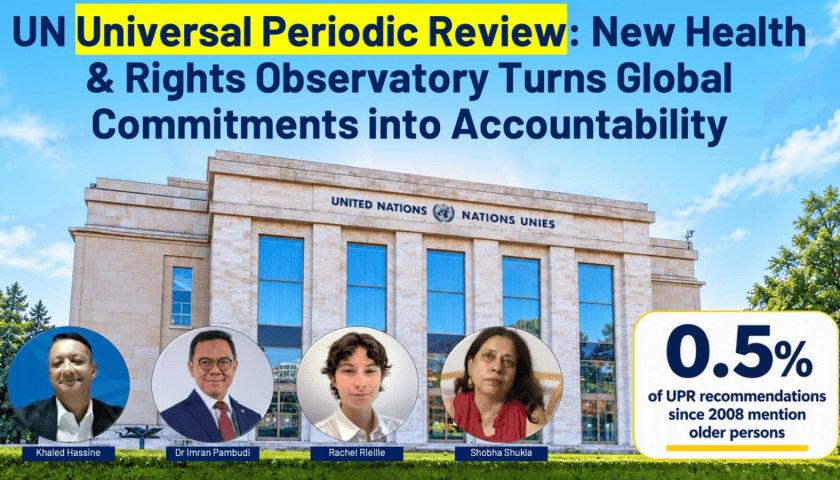
She noted that since the UPR began in 2008, only 681 of more than 124,539 recommendations have addressed older persons, representing approximately 0.5% of the total.
“When older persons are absent from data and reporting, they are absent from policy priorities,” Shukla said, urging governments to make greater use of the Health and Rights Observatory.
She added that the human rights of older persons, like those of people across all diversities, are non-negotiable and should never be treated as an afterthought.
UPR provides an entry point for stronger protection of older persons
Khaled Hassine, Secretary of the Intergovernmental Working Group on the Human Rights of Older Persons, Equality and Non-Discrimination Branch at the Office of the United Nations High Commissioner for Human Rights (OHCHR), said the UPR should be viewed as more than a mechanism for reviewing national human rights records.
He described it as an important platform for international cooperation, engagement and the development of practical recommendations that governments can implement.
Because countries review one another’s human rights records, the process provides an opportunity for governments to raise concerns through diplomatic channels and encourage action on issues identified by their peers.
Hassine said the growing visibility of older persons in UPR recommendations reflects increasing awareness of their rights and a stronger understanding of how different forms of discrimination intersect.
He also highlighted a 2016 report by the UN Independent Expert on the enjoyment of all human rights by older persons, which provided a comprehensive assessment of their human rights situation across different regions.
The report called for a global framework to strengthen international cooperation and recommended developing a legally binding international instrument specifically addressing the rights of older persons.
Hassine said the UPR could help build momentum towards such a framework by encouraging governments to make more specific commitments and strengthen their implementation efforts.
Indonesia expands primary healthcare for an ageing population
The need to translate human rights commitments into practical policies is increasingly important in Indonesia, where more than 35 million people are aged over 60, accounting for nearly 12% of the population.
Dr Imran Pambudi, Director of Vulnerable Groups Health Services at Indonesia’s Ministry of Health, described population ageing as a major public health and social challenge requiring stronger healthcare systems and community-based support.
Indonesia has adopted a life-course approach to healthy ageing through its Integrated Primary Care programme, known locally as Integrasi Layanan Primer (ILP).
The programme is being implemented across more than 9,200 government-run Puskesmas community health centres.
It brings health promotion, disease prevention, early detection, treatment and rehabilitation services closer to communities, making it easier for older persons to access essential healthcare.
The government has also introduced a free health check programme that has reached more than 12 million older persons.
The screenings assess cognitive function, mobility, nutritional status, vision, hearing and psychological wellbeing to identify health risks early and help preserve independence.
Dr Pambudi emphasised that healthy ageing involves more than preventing disease or extending life expectancy.
Older persons should also have opportunities to remain independent, participate in community activities and contribute to society.
He called for stronger primary healthcare services, sustainable financing for long-term care, greater support for caregivers and improved accessibility for persons with disabilities.
He also stressed the importance of involving older persons in decisions affecting their health and wellbeing.
As the November UPR review cycle approaches, the Health and Rights Observatory provides governments and civil society organisations with data to examine national commitments, monitor responses and identify areas where implementation remains inadequate.


Be the first to leave a comment