

Swiss Ambassador Maya Tissafi calls for gender equality and stronger women’s health rights
Women’s health has historically received insufficient research funding and attention, while medical studies have often relied predominantly on male participants.
BY Shobha Shukla – CNS (Citizen News Service)
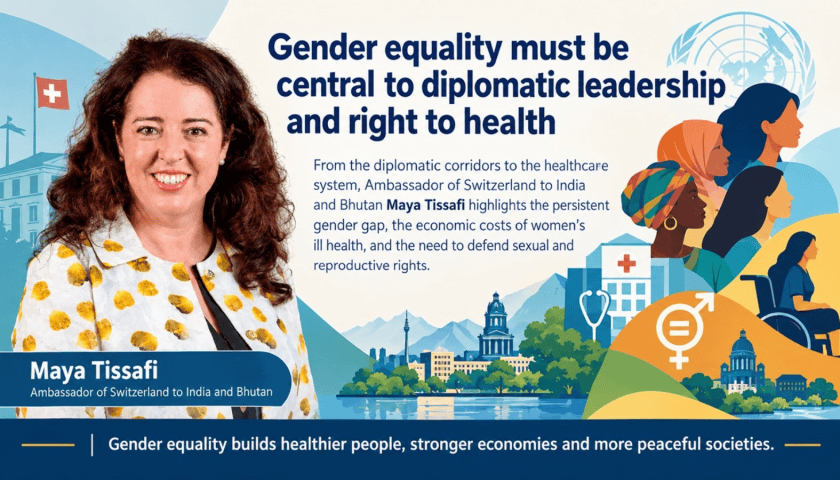
INDIA—Swiss Ambassador to India and Bhutan Maya Tissafi has called for greater gender equality in diplomatic leadership, increased investment in women’s health, and stronger protection of sexual and reproductive rights, highlighting the social and economic costs of persistent inequalities.
With 30 years of experience in diplomacy, peacebuilding and development, Tissafi has witnessed significant changes in women’s representation in diplomatic services.
However, she says progress towards genuine gender equality remains uneven.
Women’s representation in diplomacy continues to grow
Globally, women hold only about 21% of ambassadorial positions, despite representing roughly half of the world’s population.
Tissafi views this imbalance as evidence of longstanding institutional barriers, although she also points to progress in Switzerland’s diplomatic service.
“When I started my career, women were still a clear minority in diplomatic leadership,” she said.
Women now make up 40.3% of Switzerland’s diplomatic corps, an increase of approximately 10 percentage points since 2013.
They also account for nearly 36% of Swiss ambassadors serving abroad, exceeding the global average of 21%.
The Swiss Federal Department of Foreign Affairs (FDFA) aims to achieve representation of 45% to 55% for both women and men at every hierarchical level by 2028.
Tissafi discussed these issues in an exclusive interview with CNS ahead of the SHE & Rights session on gender equality and the human right to health.
She said the priority was to sustain progress and ensure that future generations of women diplomats would not face the same barriers as their predecessors.
“Diplomacy is no exception to institutions that were historically shaped by and for men,” she said.
Diplomatic careers often require frequent relocations, repeated overseas postings and extended periods away from home.
These demands can be difficult to reconcile with caregiving responsibilities, which still fall disproportionately on women.
Informal professional networks, leadership stereotypes and a shortage of visible female role models can further restrict their advancement.
However, Tissafi believes that greater representation can help change these institutional cultures.
When women lead diplomatic missions, negotiate agreements and participate directly in decision-making, they challenge traditional assumptions about leadership.
“Once women are present in the room, not simply as participants, but as ambassadors, negotiators and decision-makers, perceptions change as well,” she said.
Women’s health is essential to economic development
Tissafi’s understanding of gender equality extends beyond diplomatic representation.
Her experience includes work on health-sector reforms in Tanzania, while her academic background includes a Master of Public Health.
These experiences have shaped her perspective on the social and institutional barriers women face when seeking healthcare.
“My background in public health has taught me that health outcomes are never simply biological. They are shaped by social conditions, economic opportunities and political decisions,” she said.
Women’s health has historically received insufficient research funding and attention, while medical studies have often relied predominantly on male participants.
This imbalance can affect the understanding, diagnosis and treatment of conditions that affect women differently.
At the same time, millions of women continue to face barriers to maternal, sexual and reproductive healthcare.
Tissafi argues that policymakers must also recognise the economic consequences of poor women’s health.
Ill health can interrupt girls’ education, limit women’s participation in the workforce, reduce their earnings and increase their unpaid caregiving responsibilities.
These effects can deepen household poverty and prevent countries from fully benefiting from women’s skills and economic contributions.
“Investing in women’s health is not only a matter of human rights and health equity. It is also an investment in human capital, economic participation and sustainable growth,” she said.
She called for a broader approach that places women’s health at the centre of public health, equality and development policies rather than treating it as a specialised concern.
“We need to stop thinking of women’s health as a specialised or secondary issue. It is a core issue of health, equality, human rights and economic development,” she said.
Switzerland faces wider debates over women’s rights
Despite its established institutions and commitment to human rights, Switzerland is not insulated from international debates over gender equality.
Tissafi acknowledged that the country faces increasingly polarised discussions about reproductive rights, gender-based violence and women’s roles in society.
“Switzerland is not immune to the broader pushback against gender equality and women’s rights that we are seeing internationally,” she said.
However, she pointed to the country’s constitutional and legal protections, active civil society and longstanding human rights commitments as important safeguards.
Gender equality and women’s rights also remain integral to Switzerland’s international human rights diplomacy.
The FDFA has identified several priorities for advancing gender equality, including strengthening women’s economic empowerment and political participation, combating gender-based violence, promoting sexual and reproductive health and rights, and integrating gender equality into bilateral and multilateral engagement.
At the 70th session of the United Nations Commission on the Status of Women (CSW70), Switzerland also emphasised equal and effective access to justice for women and girls, stronger rule of law and accountability, and efforts to combat gender-based violence, including conflict-related sexual violence.
Other priorities included women’s equal participation in decision-making, protecting civic space, and addressing the specific needs of older women and women in detention.
Switzerland’s work on the Women, Peace and Security agenda further seeks to strengthen women’s participation in conflict prevention and peace processes while protecting them from sexual and gender-based violence during conflicts.
Tissafi said the response to challenges against gender equality should focus on clearly communicating the principles involved and demonstrating their benefits.
“The way forward is not to become defensive when these issues are challenged. It is to stand up clearly for the principles we believe in, demonstrate their value with evidence, and keep building broad support for equality,” she said.
She added that gender equality should not be framed as a competition in which advancing women’s rights comes at the expense of others.
“Gender equality is not a zero-sum game. It strengthens societies, economies and, ultimately, peace and stability,” she said.
Protecting sexual and reproductive rights
Tissafi also highlighted safe abortion as an important component of sexual and reproductive healthcare.
When women cannot access safe and timely services, she said, the consequences can extend beyond their immediate health to affect their social and economic participation.
She argued that women should have access to reliable information and appropriate healthcare to make informed decisions about their bodies and health.
“Women must be able to make decisions about their own bodies and their own health, based on evidence, dignity and access to appropriate healthcare. For me, this is ultimately about dignity, equality and the right to make informed decisions about one’s own life,” she said.
Amid polarised debates about abortion, Tissafi urged stakeholders to keep the experiences of affected women at the centre of discussions.
“We should not lose sight of the women behind the debate: their health, their choices and their dignity must remain at the centre,” she said.

Be the first to leave a comment