Warning: unserialize(): Error at offset 61440 of 61440 bytes in /home/healthcareme/www/www/wp-content/plugins/divi-builder/core/components/cache/File.php on line 79
Abu Dhabi Biobank partners with Bascom Palmer to open Middle East’s first eye bank
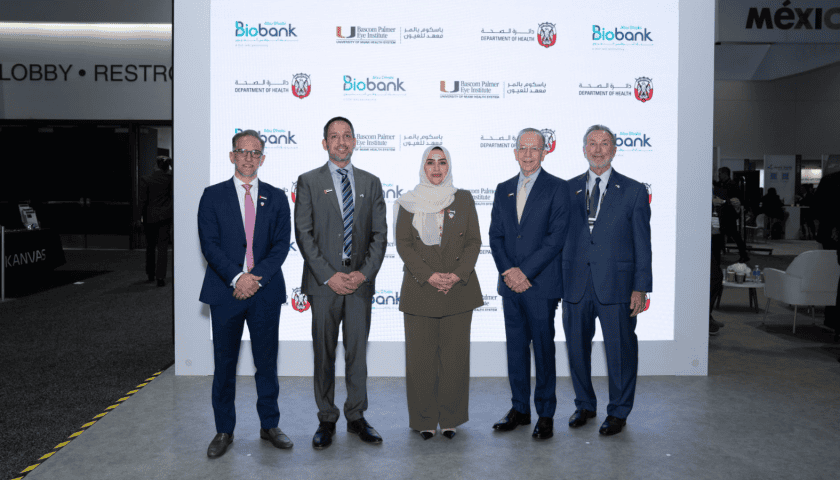
The agreement was announced during the BIO International Convention 2026 in San Diego, California, and is expected to strengthen corneal transplantation services while improving access to sight-restoring care across the UAE and the wider region.
Published
USA— Abu Dhabi Biobank (ADBB), a strategic initiative of the Department of Health – Abu Dhabi (DoH) and M42, has signed a collaboration agreement with Bascom Palmer Eye Institute, part of the University of Miami Health System, to establish the Middle East’s first eye bank in Abu Dhabi.
The agreement was announced during the BIO International Convention 2026 in San Diego, California, and is expected to strengthen corneal transplantation services while improving access to sight-restoring care across the UAE and the wider region.
Building regional transplant capacity
The Abu Dhabi Biobank–Eye Bank represents a major step in expanding the emirate’s transplant and biobanking infrastructure.
It follows last year’s partnership between DoH and Bascom Palmer Eye Institute, which led to the establishment of the institute’s first international facility in Abu Dhabi.
That collaboration brought the US-based centre’s specialist ophthalmic care, research programmes and medical education expertise to the region, reinforcing Abu Dhabi’s ambitions to become a global healthcare destination.
Dr. Noura Khamis Al Ghaithi, Undersecretary of the Department of Health – Abu Dhabi, said the emirate continues to expand access to specialised healthcare by working with world-leading medical institutions.
She noted that the partnership with Bascom Palmer Eye Institute reflects Abu Dhabi’s commitment to innovation, international collaboration, and patient-centred care, while ensuring that residents can receive advanced treatment closer to home.
She added that establishing local eye banking capabilities will give patients in the UAE faster and more reliable access to corneal transplants.
It will also reduce dependence on imported donor tissue, strengthen regional self-sufficiency and improve access to life-changing treatment.
Creating a local supply of donor tissue
The new eye bank will recover, process, preserve and distribute donor corneal tissue according to international standards, creating a secure local supply chain from donation to transplantation.
The facility is expected to reduce supply shortages, minimise logistical delays associated with importing tissue and improve quality assurance, traceability and patient outcomes.
Albarah El Khani, Chief Operating Officer of Integrated Health Solutions at M42, said the initiative creates critical healthcare infrastructure that will restore sight for patients while strengthening long-term transplant capabilities across the Middle East.
She said Abu Dhabi Biobank is laying the foundation for a more resilient and innovation-driven healthcare system, adding that Bascom Palmer’s expertise will ensure the eye bank operates according to the highest international standards from its launch.
Supporting research and clinical training
Dr. Zain Kenderian, Chief Executive Officer of Bascom Palmer Eye Institute Abu Dhabi, said the institute has spent more than 60 years advancing ophthalmic care, research and education.
He explained that the new eye bank will serve not only as a tissue repository but also as an important research platform supporting transplantation science, clinical training and innovation throughout the region.
The eye bank will also work closely with Hayat, the UAE’s national organ donation programme, to coordinate the recovery, processing, preservation, and distribution of corneal tissue.
The announcement comes just days after Abu Dhabi Biobank unveiled another partnership during the BIO International Convention, joining forces with BioTwin to deploy AI-powered Virtual Human Twin technology for earlier disease detection, preventive care and precision medicine.
The collaboration further expands the biobank’s role in connecting biological samples with genomic, clinical, and AI-driven data to accelerate medical research and personalised healthcare.
Sign up HEREto receive our email newsletters with the latest news and insights from Africa and around the world, and follow us on LinkedInfor updates.


Be the first to leave a comment