

Ethiopia hosts first WHO Emergency Medical Teams Global Meeting in Addis Ababa
The Ethiopian government is hosting the meeting in collaboration with WHO, with support from the Macao Special Administrative Region (SAR) and the Robert Koch Institute.
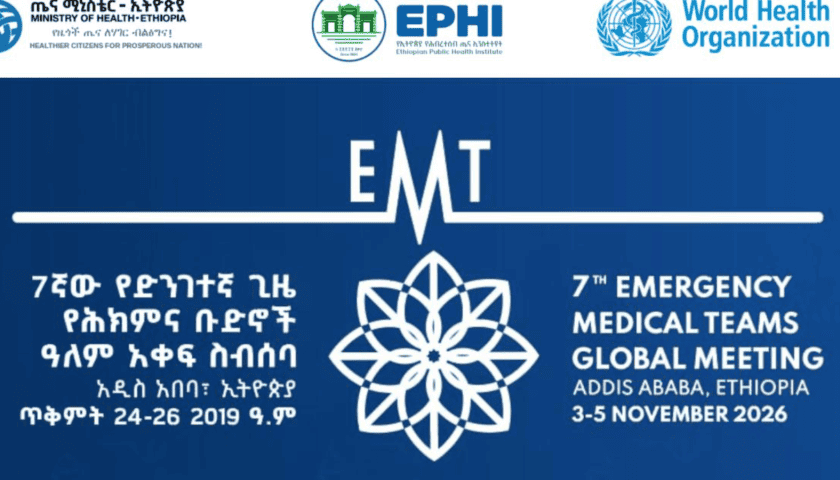
ETHIOPIA – The World Health Organization (WHO) and the Government of Ethiopia are hosting more than 800 participants from over 100 countries in Addis Ababa from 3 to 5 November 2026 to strengthen national capacity to deliver timely, quality healthcare during emergencies.
The seventh Emergency Medical Teams (EMT) Global Meeting is the first to take place in the WHO African Region.
It brings together government representatives, healthcare professionals, researchers and humanitarian organisations to discuss how countries can develop and sustain national emergency medical teams.
The Ethiopian government is hosting the meeting in collaboration with WHO, with support from the Macao Special Administrative Region (SAR) and the Robert Koch Institute.
Discussions draw on the EMT 2030 Strategy and lessons from recent emergencies, focusing on sustainable financing, quality standards, operational readiness, and international cooperation.
Strengthening national emergency response systems
Emergency Medical Teams comprise trained and equipped healthcare professionals who provide clinical services during disease outbreaks, natural disasters, conflicts and other emergencies.
They operate under the affected country’s national coordination structures, supporting existing health services and delivering care in line with internationally recognised standards.
Ethiopia’s efforts to strengthen this capacity gained international recognition in September 2026, when its national EMT received WHO international classification following an assessment of its clinical services, logistics and operational readiness against established standards.
Across the WHO African Region, 30 countries are developing national EMT capabilities under the Regional Framework on Emergency Medical Teams 2026–2030.
WHO supports these efforts through technical guidance, mentoring and readiness assessments.
The Regional EMT Training and Knowledge Hub in Addis Ababa also provides a platform for professional training, simulation exercises and knowledge exchange.
These initiatives aim to improve workforce preparedness and strengthen coordination between national response teams and international partners.
Developing operational teams requires more than recruiting healthcare professionals.
Governments must establish arrangements to release staff from routine duties, maintain medical equipment, finance deployments, and transport supplies during emergencies.
Sharing practical experiences can help countries address these challenges and identify areas where external technical and financial support is needed.
Financing and workforce readiness
“Strong national teams give countries more capacity to respond quickly and organize assistance according to local needs,” said Professor Francis Chisaka Kasolo, WHO Representative to Ethiopia.
He noted that hosting the meeting in the African Region brings national experiences into global discussions and creates an opportunity to strengthen support for emergency teams before crises occur, as well as improve coordination during responses.
The discussions also address the investment required to maintain operational readiness, including predictable financing, regular training, adequate equipment and reliable deployment systems.
These capabilities are important for health ministries and development partners planning investments in emergency preparedness, workforce development and resilient health systems.

Be the first to leave a comment