

India’s community health workers help MDR-TB patients overcome treatment barriers in Delhi
Interruptions in MDR-TB treatment can compromise treatment outcomes, prolong illness, and increase the risk of continued transmission.
BY Shobha Shukla – CNS (Citizen News Service)
INDIA—Ahead of World AMR Awareness Week 2026, community health workers in Delhi are helping people with drug-resistant tuberculosis (TB) remain on treatment by connecting vulnerable patients with public health facilities, nutritional assistance, and financial support.
For people with drug-resistant TB, accessing an accurate diagnosis and appropriate medicines is only part of the treatment process.
Poverty, insecure livelihoods, migration, and physical disabilities can make it difficult to attend medical appointments, maintain treatment schedules and complete therapy.
Shobha Shukla, a health and development justice advocate and managing editor at CNS, says that these social and economic barriers could undermine recovery, particularly among populations with limited access to healthcare.
The experience of Mahesh (name changed to protect his identity), a 55-year-old daily-wage worker living in a densely populated settlement in central Delhi, illustrates the role of community health workers, healthcare providers, and government support programmes in maintaining treatment continuity.
Livelihood insecurity disrupts MDR-TB treatment
Mahesh lives with his wife, 22-year-old son, and other family members in a small, overcrowded house.
His household depends largely on his daily earnings, making the family financially vulnerable whenever illness prevents him from working.
In early 2025, he developed persistent high fever, severe body aches and extreme weakness.
He initially sought treatment from private practitioners, but the medicines provided little relief.
As his condition deteriorated, a doctor referred him to the government-run Jhandewalan Chest Clinic for further investigations.
The clinic conducted an X-ray and sputum examination, while the government-run Dr NC Joshi Memorial Hospital performed an ultrasound.
The investigations confirmed multidrug-resistant tuberculosis (MDR-TB), a form of TB in which the bacteria resist at least two of the most powerful first-line medicines, isoniazid and rifampicin.
Mahesh said he was the first person in his family to develop TB. He started treatment in April 2025.
However, as his health improved, he resumed travelling outside Delhi in search of employment.
His dependence on daily-wage work meant that remaining at home to recover could result in lost income.
Frequent travel also made it difficult to attend follow-up appointments and maintain his medication schedule.
He eventually stopped taking his medicines.
Interruptions in MDR-TB treatment can compromise treatment outcomes, prolong illness, and increase the risk of continued transmission.
They can also contribute to the development of additional drug resistance, making subsequent treatment more difficult and potentially more expensive.
Mahesh’s circumstances illustrate how livelihood insecurity can undermine treatment adherence even after patients have accessed diagnosis and started appropriate medication.
Community outreach reconnects patients with healthcare
In October 2025, during a routine door-to-door TB screening campaign, Shimpi and Geeta, field officers working with Humana People to People India (HPPI), encountered Mahesh in his neighbourhood.
Geeta is a TB survivor whose personal experience helps her relate to people undergoing treatment and provide practical and emotional support.
After learning about Mahesh’s treatment interruption, Shimpi held several counselling sessions with him.
She explained the importance of completing his prescribed MDR-TB treatment and discussed the consequences of discontinuing medication for his recovery and the health of people around him.
Her engagement focused on addressing his concerns, building trust and encouraging him to return to the public healthcare system.
Following continued counselling and support, Mahesh agreed to restart treatment.
Shimpi accompanied him to Jhandewalan Chest Clinic, coordinated with the medical team and requested that healthcare providers reinstate his medication.
He resumed treatment, taking seven tablets every morning after breakfast.
Although he experienced hot flushes after taking the medicines, he managed to undertake some light work to support his household.
However, another setback threatened his progress.
Home-based medicine delivery prevents treatment interruption
Mahesh subsequently suffered an accident that fractured his legs.
Doctors prescribed complete bed rest, preventing him from travelling to the chest clinic to collect his medication.
Given his previous treatment interruption, the injury raised concerns about another break in therapy.
Shimpi informed the clinic’s doctors about his condition and requested an alternative arrangement to maintain his medication supply while he recovered.
She also committed to continuing her follow-up visits and supporting his adherence.
The healthcare team approved the request, allowing Shimpi to collect Mahesh’s medicines from the clinic and deliver them directly to his home until he regained mobility.
This arrangement linked community-based outreach with public healthcare delivery, allowing the clinic to maintain treatment continuity without requiring the patient to make repeated journeys.
Mahesh has since recovered sufficiently to visit the facility and collect his medication independently.
Such flexible arrangements are relevant to TB service delivery in densely populated urban settlements, where transport costs, physical disabilities and insecure employment can prevent patients from accessing facility-based services.
Home-based follow-up and coordination between community organisations and public clinics can help address these barriers.
Government programmes provide nutritional and financial assistance
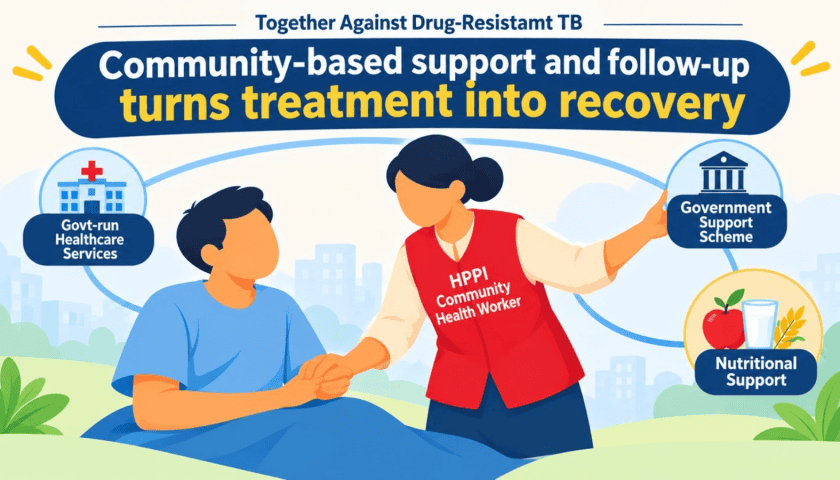
Beyond facilitating access to medicines, Shimpi and Geeta helped Mahesh obtain nutritional and financial assistance through government programmes.
He received nutritional support twice under the Government of India’s Pradhan Mantri TB Mukt Bharat Abhiyaan, which mobilises community and institutional support for people undergoing TB treatment.
He also received INR 1,000 (US$10.70) per month through the Ni-Kshay Poshan Yojana, a government scheme that provides nutritional assistance to eligible TB patients through direct bank transfers.
The payments covered the months when he remained on treatment but stopped during the period when he discontinued medication.
For patients who depend on daily wages, even modest financial assistance can help meet basic household and nutritional needs while illness limits their ability to earn.
These interventions also demonstrate the importance of integrating TB services with social protection programmes.
Nutritional support, financial assistance and community follow-up address some of the non-medical factors that influence treatment adherence, particularly among economically vulnerable populations.
Frontline workers strengthen links with public health facilities
Mahesh credited the support he received from the community health workers with helping him remain on treatment.
“I could not have adhered to MDR-TB treatment without the help of didi,” he said.
Didi, a Hindi term for sister, is how he addresses Shimpi, reflecting the relationship she established with him during his treatment.
For Shimpi, supporting people who struggle to access healthcare remains an important part of her work.
“It gives me genuine satisfaction to help people who are surrounded by problems so much so that they are not able to reach even a nearby chest clinic on their own,” she said.
“Trying to help them access health services gives me tremendous energy and hope to keep striving on. I do not work here just to earn a living but also to render services to other needy human beings.”
Her work illustrates how community-based organisations can complement government healthcare services through patient identification, counselling, treatment follow-up and coordination with medical facilities.
TB survivors working alongside frontline health workers also bring lived experience that can help build trust and encourage patients to remain engaged with care.
Social barriers remain central to drug-resistant TB care
TB remains a major public health challenge globally, with its burden falling disproportionately on populations affected by poverty, overcrowded housing, insecure employment and limited access to healthcare.
For key and other vulnerable populations, barriers to TB services often overlap.
Stigma, delayed diagnosis, migration, inadequate nutrition, financial constraints and difficulties travelling to health facilities can affect both treatment initiation and completion.
These challenges have implications for healthcare delivery and the broader response to antimicrobial resistance (AMR).
Interruptions in drug-resistant TB treatment can increase the risk of poor clinical outcomes and further resistance, placing additional demands on diagnostic services, treatment programmes and healthcare resources.
As India advances its TB elimination programme, community-based screening and follow-up need to remain closely connected to public health facilities, reliable medicine supplies and social protection mechanisms.
Healthcare providers and implementing organisations also need flexible service delivery arrangements that account for patients’ employment, mobility, financial circumstances and other individual needs.
World AMR Awareness Week 2026 and the Union World Conference on Lung Health provide an opportunity to highlight these challenges in the management of drug-resistant TB, particularly among populations that face persistent barriers to healthcare access.
Be the first to leave a comment