

UNEP calls for stronger environmental action to combat antimicrobial resistance
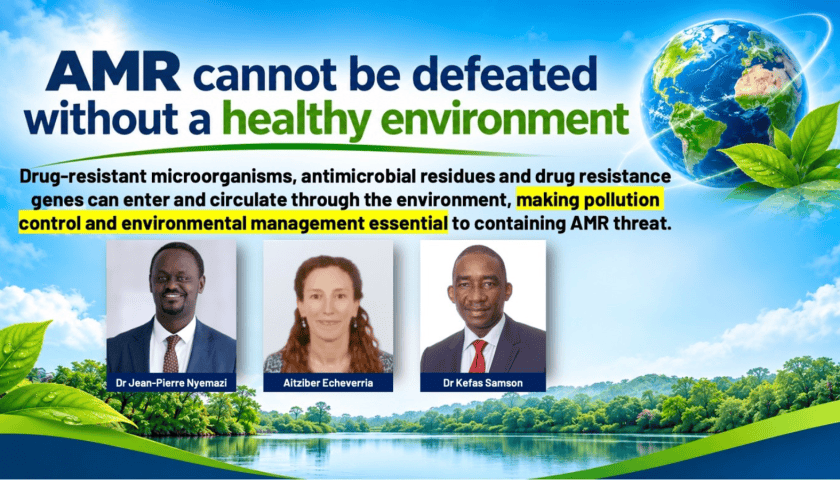
Antimicrobial residues, drug-resistant microorganisms and resistance genes can enter the environment through industrial discharges, agricultural activities and inadequately treated waste and wastewater, creating conditions that encourage resistance to emerge and spread.
BY Shobha Shukla – CNS (Citizen News Service)
GLOBAL — The United Nations Environment Programme (UNEP) has called on countries to strengthen environmental protection as part of global efforts to combat antimicrobial resistance (AMR), warning that inadequate pollution control and environmental monitoring could undermine progress in human and animal health.
The agency is urging governments to move beyond political commitments and implement practical measures to prevent antimicrobial pollution, strengthen environmental surveillance and increase investment in sustainable waste and wastewater management.
Aitziber Echeverria, AMR Coordinator in UNEP’s Chemicals and Health Branch, said the environment must become a central part of the global AMR response rather than remain a secondary consideration.
“AMR is often discussed as a public health and agriculture challenge, which of course it is, and a major one, but it is an environmental issue too,” Echeverria said.
Her remarks reflect growing recognition that AMR extends beyond hospitals, farms and healthcare facilities.
Antimicrobial residues, drug-resistant microorganisms and resistance genes can enter the environment through industrial discharges, agricultural activities and inadequately treated waste and wastewater, creating conditions that encourage resistance to emerge and spread.
Speaking at the sixth Annual Global Media Forum on AMR ahead of World AMR Awareness Week (WAAW 2026), scheduled for November 18–24, Echeverria cited UNEP’s report Bracing for Superbugs, which examines the environment’s role in the emergence and spread of antimicrobial resistance.
She said environmental protection must be integrated into the One Health approach, which recognises the interconnected health of people, animals, plants and ecosystems.
From political commitments to environmental action
Echeverria said global discussions on AMR had increasingly acknowledged the environmental dimension of the problem, but countries now needed to translate this recognition into practical interventions.
“We are moving now from recognising the environmental dimensions of AMR to systematically addressing them. We now need implementation,” she said.
The 2024 United Nations General Assembly Political Declaration on AMR reinforced the need for coordinated action across sectors. Echeverria stressed that governments must incorporate environmental priorities into national AMR strategies rather than address them separately.
As part of these efforts, Member States adopted a resolution on the environmental dimensions of AMR in December 2025 during the United Nations Environment Assembly, the UN’s highest decision-making body on environmental matters.
According to Echeverria, preventing pollution at its source should be a priority.
This requires reducing the release of antimicrobial residues, resistant microorganisms and resistance genes into the environment before they contribute to the development and transmission of resistance.
She identified four economic sectors that require targeted interventions.
The first is pharmaceutical and chemical manufacturing, where industries must reduce discharges containing antimicrobial residues.
The second is agriculture and food production, including terrestrial and aquatic animal farming and crop production, where more sustainable practices can limit environmental contamination.
Healthcare systems form the third priority area, particularly through responsible antimicrobial use and stewardship to minimise unnecessary releases.
The fourth is municipal waste and sanitation management, where untreated or inadequately treated wastewater and solid waste can contribute to the spread of resistant microorganisms.
Echeverria said interventions across these sectors must work together because environmental pollution generated by one industry can affect human, animal and ecosystem health.
Environmental surveillance to identify AMR hotspots
Beyond pollution prevention, UNEP is calling for stronger environmental monitoring and surveillance systems to help countries identify sources of antimicrobial contamination and detect emerging resistance threats.
Echeverria said environmental data could provide early warnings about AMR hotspots, allowing governments to identify areas requiring targeted interventions.
“Countries need stronger environmental monitoring and surveillance systems because environmental data can provide an early warning of AMR hotspots and sources, which can help identify where and which interventions are needed,” she said.
The establishment of the Independent Panel on Evidence for Action against AMR (IPEA), expected to take place in Abuja during the Fifth Global High-Level Ministerial Conference on AMR, is another development aimed at strengthening the evidence available to policymakers.
However, Echeverria warned that stronger evidence alone would not deliver progress unless countries also addressed gaps in environmental governance.
She noted that environmental authorities often remain excluded from national AMR decision-making, resulting in fragmented policies and regulations that separate environmental protection from public health and agricultural priorities.
She called for environmental institutions to participate formally in national AMR coordination structures from the outset, rather than being consulted after governments have developed their strategies.
Echeverria also urged countries to include measurable environmental targets and indicators in their national AMR action plans, supported by adequate funding.
Investment in pollution control and waste management
Implementing environmental interventions will require sustained investment in infrastructure, laboratory capacity and surveillance systems.
Echeverria identified improved wastewater treatment, safe disposal of antimicrobial products, stronger laboratory networks and environmental AMR data collection as priority areas for funding.
She said governments could also align AMR investments with existing environmental programmes covering pollution reduction, water quality, chemical management, waste management and sustainable production and consumption.
Such investments could deliver benefits beyond AMR prevention by improving public health, protecting biodiversity and strengthening water security.
They would also support efforts to address the interconnected challenges of climate change, biodiversity loss and pollution, collectively known as the triple planetary crisis.
WHO warns of widening implementation gap
The need to translate international commitments into practical action was also highlighted by Dr Jean-Pierre Nyemazi, Acting Director of WHO’s AMR Department and Director of the Quadripartite Joint Secretariat on AMR.
He described AMR as one of the most urgent global health threats and development challenges, warning that it undermines the ability to treat infections, protect animal and plant health and produce safe food.
Nyemazi noted that bacterial AMR alone was associated with more than 4.7 million deaths in 2021.
“These are not just statistics. Behind these numbers are patients, families, farmers and communities,” he said.
He attributed the growing threat to interconnected challenges, including the misuse and overuse of antimicrobials, inadequate infection prevention and control, poor water and sanitation services and environmental contamination.
“AMR does not recognize borders or sectors,” he said.
The 2024 UN Political Declaration established targets for 2030, including reducing deaths associated with bacterial AMR by 10% and ensuring that at least 60% of countries have funded national AMR action plans.
However, Nyemazi warned that implementation continues to lag behind international commitments.
“The gap between commitments and pledges versus implementation remains wide,” he said.
The updated Global Action Plan on AMR for 2026–2036 and the Fifth Global High-Level Ministerial Conference on AMR, scheduled for December 6–8, 2026, in Abuja, Nigeria, are expected to advance international coordination and accelerate national action.
Nyemazi stressed that governments must translate these commitments into interventions that deliver measurable improvements at community level.
Countries urged to strengthen national AMR programmes
Dr Kefas Samson, Senior Technical Officer and Lead of Multisectoral Coordination at WHO’s AMR Department, highlighted the importance of adapting global AMR strategies to national priorities and local circumstances.
He said governments should assess their needs, identify priority interventions, estimate implementation costs and align their plans with available resources.
Samson also emphasised the role of primary healthcare and community-based services in promoting responsible antimicrobial use, strengthening infection prevention, supporting early diagnosis and ensuring timely and appropriate treatment.
However, he identified several persistent barriers to progress, including inadequate financing, weak surveillance systems, limited diagnostic capacity, gaps in access to quality-assured antimicrobials and shortages of healthcare workers.
He said the updated Global Action Plan on AMR for 2026–2036 places greater emphasis on coordinated One Health action across human health, animal health, agriculture and the environment.
Echeverria reiterated that countries must give environmental protection a central role in their AMR strategies, particularly by strengthening cooperation between sectors to reduce pollution from antimicrobial products, resistant microorganisms and resistance genes.
She warned that neglecting environmental drivers could undermine progress in human and animal health.
“If we do not address the environmental dimensions of AMR, we risk undermining efforts in human and animal health,” she said.
She also called for countries to redirect existing investments and incentive programmes towards pollution prevention, sustainable production and integrated One Health interventions.
Investing in these areas, she said, would help curb the emergence and spread of AMR while supporting sustainable development and protecting future generations.
Be the first to leave a comment