Moscow Radiology Centre showcases AI advances at UN-backed ‘AI for Good’ Summit
The United Nations (UN) and the International Telecommunication Union (ITU) organised the summit as a platform for advancing practical AI solutions that support the Sustainable Development Goals.
Published
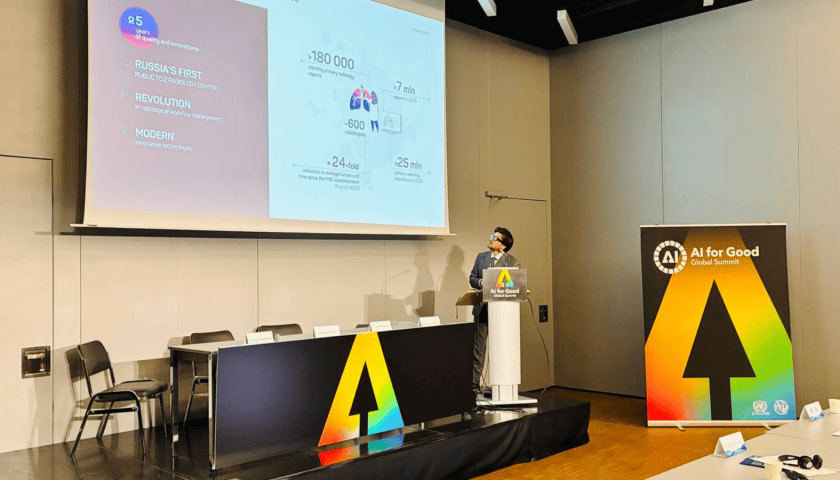
RUSSIA— Moscow’s Center for Diagnostics and Telemedicine has showcased the city’s experience in applying artificial intelligence (AI) to healthcare at the “AI for Good” Summit, held in Geneva, Switzerland, from July 6 to 11, 2026.
The United Nations (UN) and the International Telecommunication Union (ITU) organised the summit as a platform for advancing practical AI solutions that support the Sustainable Development Goals.
Government agencies, international organisations, scientists, and technology companies attended the event to discuss AI standardisation, regulation and applications across sectors, including healthcare.
AI in medical imaging
Yuri Vasiliev, Chief Officer of Radiology at the Moscow Health Care Department and Medical Director of the Center for Diagnostics and Telemedicine, said participation in the summit would help strengthen the centre’s international professional network and promote collaboration on digital healthcare.
As part of the programme, Vasiliev presented a paper at a seminar titled “Brain-Computer Interface: Technology for Good and Application Cooperation.”
He discussed how AI and neuroimaging technologies can support the detection of intracranial haemorrhages and ischemic changes, as well as the analysis of magnetic resonance imaging (MRI) scans in patients with multiple sclerosis.
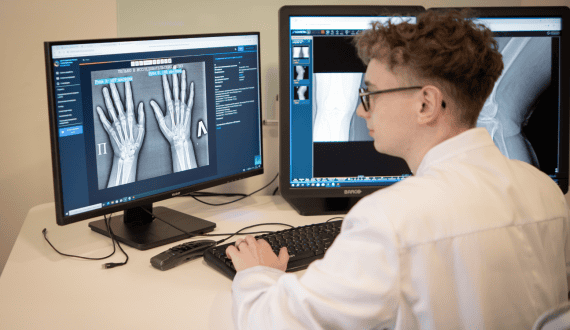
According to Vasiliev, neural networks can help clinicians interpret medical images more quickly and accurately.
However, he noted that the technologies remain at different stages of development, with some already used routinely in clinical practice while others are still undergoing clinical trials.
Moscow expands AI use in radiology
Vasiliev also presented findings from a six-year Moscow experiment on the use of computer vision in radiology.
Since 2020, AI technologies have helped radiologists process more than 18 million scans.
The initiative has supported the development of methods for evaluating AI algorithms, an open library of medical datasets and a market for locally developed AI healthcare services.
Through the MosMedAI platform, more than 2,000 medical organisations across 75 Russian regions have accessed verified AI services, supporting the wider adoption of AI-based radiology practices.
The Moscow approach to standardising AI in healthcare has also attracted international attention.
The framework covers technology development, data preparation, technical and clinical testing, ongoing monitoring and quality control.
Russia has developed 28 national standards for applying AI in healthcare, according to the centre.
AI readiness framework presented at WHO
Vasiliev also presented Moscow’s experience at the World Health Organization (WHO) headquarters in Geneva, alongside representatives of the Moscow Department of Information Technology.
The session focused on methods for integrating AI into routine healthcare and introduced a “maturity matrix” designed to assess the readiness of AI services.
The framework evaluates technical reliability, including the rate of technological defects, and diagnostic performance using the area under the receiver operating characteristic curve (AUC-ROC).
Medical organisations can use the tool to assess AI solutions for clinical deployment, while developers can monitor the progress of their technologies from initial participation in the Moscow experiment through market launch and wider healthcare adoption.
The Center for Diagnostics and Telemedicine supports Moscow’s healthcare system through research and education, while advancing radiology, instrumental diagnostics, digital health and the practical application of AI in medicine.
Sign up HEREto receive our email newsletters with the latest news and insights from Africa and around the world, and follow us on LinkedInfor updates.



Be the first to leave a comment